Thursday, 29 September 2016

A Touch of Tweed

At this time of year, with the change of season, one starts to think about all the cosy things in life, warm bowls of soup on rainy days, fluffy new socks and, if you make your own clothes – or like to have something cosy made, woolly things to wear.  You might like knitting or crochet and love nothing better than to have a new project keeping your lap warm and whiling away your evenings in front of costume dramas (I love Poldark, and Victoria – and Downton Abbey, oh how I miss Downton).  Me, I like riffling through my fabric boxes pulling together fabrics to make jackets and coats, redesigning them and referring to all the new season’s colours.  Not forgetting the all-important buttons – I spend ages deliberating over buttons!

The most versatile, hard wearing and divers fabric used in jackets and coats is Wool, which is incredibly hard wearing, gorgeously warm and acts a bit like plasticine with a bit of steam; it also moulds beautifully to the wearer over time – which is why when you try on a well-worn vintage jacket it feels weird until you have worn it in for yourself.  I used to have a huge WWII Naval Trench Coat in my early 20s which I wore with a tiny, tiny skirt, thigh length suede boots along with my bright red, corkscrew permed hair – thinking I was the bees knees.   The most fantastic wool fabric one can get is Tweed.

Tweed can be grouped together in to four main styles; 

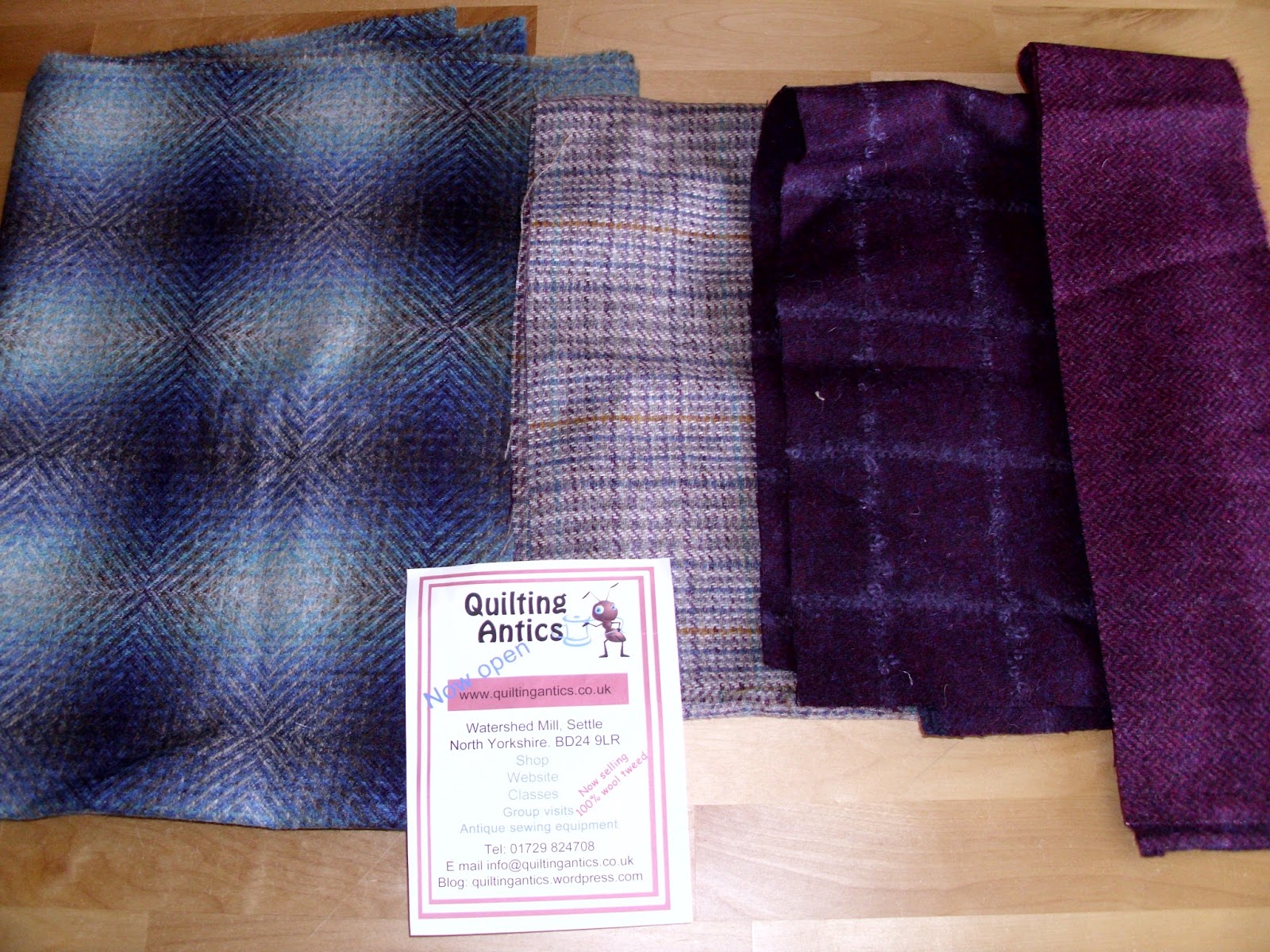
Plain Tweed, on the left is shot Black & White and on the right is a printed plain tweed.

Plain Tweed can be bold or subtle, some are made with fibres that have been dyed before spinning and create the soft heather tones you see sometimes.  Some use two colours of thread such as the shot version in the photo above, and then others are embellished with printed patterns after weaving such as the one in the picture. 

Twill woven Tweeds

Twill woven Tweeds are generally in one single colour and come in a wide range of weights from very soft fine fabric to rather chunky and blanket like cloth.  If any of you see me out and about on really cold days you will see me in my orange coat made out of the orange tweed on the right of the picture. 
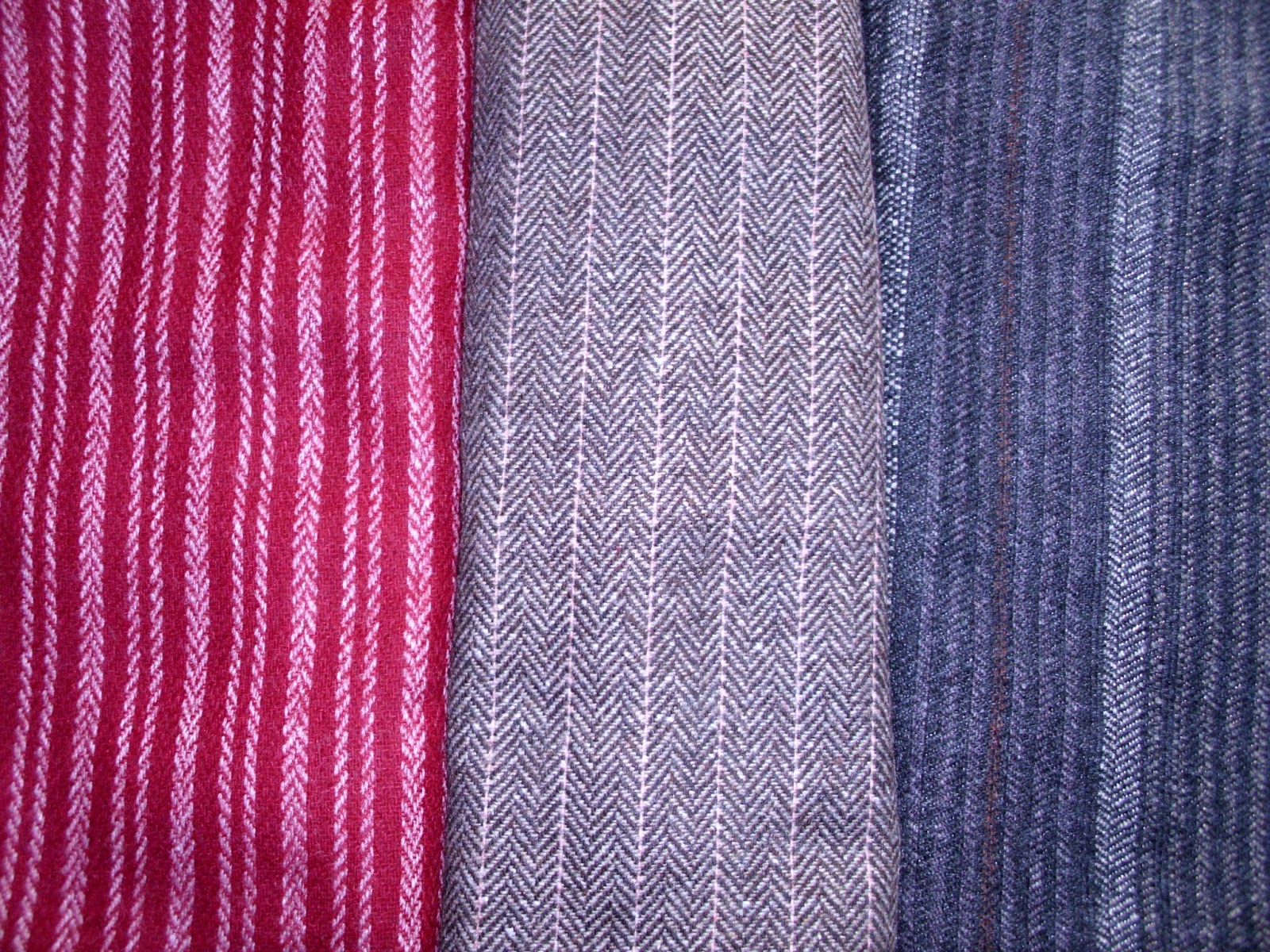
Herringbone Tweed is varied in pattern dependant on the design of the cloth to be made

The Herringbone Tweed in the centre is very traditional and would be what most folk would imagine when they think of Herringbone Tweeds.  Either side are less traditional patterns that incorporate a variety of colours. 

Check Tweeds are even more varied in their pattern and use of colours

Check Tweeds are probably the most widely worn, and the tweed with the strongest associations with tailoring and culture.  In Scotland each one of the Clans has their own design of Tartan patterned Tweed which were greatly popularised by Queen Victoria and Prince Albert in the 19th Century after their first visit to Balmoral early in their marriage.  Nowadays there are a massive range of checked Tweeds to choose from, I particularly like a lot of the upholstery designs such as the second from the left in the above pic; it seems that weavers are letting loose their creativity and I for one love it.

The most famous Tweed cloth is probably Harris Tweed which has a long history and protected status nowadays.  The weavers all live on and around the Isles of Harris and Lewis in the Outer Hebrides in Northern Scotland and some produce their work as part of their life as Crofters, using local wool fleece, which is dyed locally and blended to produce the myriad of tones and colours that is unique to Harris Tweed as part of a cooperative group.  This is such a beautiful cloth and is a joy to design and work with.  Given the quality and special nature of this fabric it is in my humble opinion the pinnacle of wool fabrics and it is very good value for money.  One is only limited by your imagination when putting it to use – during my final degree collection I made a lined Bra with sky blue basket weave Harris Tweed, it was most pretty.

Every so often I go window shopping online to drawl over all the delicious colours and patterns that are available at Dashing Tweeds. I was lead to them by another tailor a couple of years ago who is also excited by all the pretty things they produce.

While on holiday in Yorkshire some time back I came across an outlet at the Courtyard Centre   where there was an shop stocking really inspiring jackets.  I got rather excited by the piano facings and creative use of patterned linings and bindings inside these jackets which were produced using Moon Tweeds which are made locally in one of the last remaining mills where raw wool is processed from fleece to finished cloth in the UK.  This year I discovered a smaller outlet that stocks offcuts of Moon cloth for craft uses at Quilting Antics just outside Settle where you can obtain it by the metre or by weight, if you take a look at the Moon website you can contact Quilting Antics and see if they have small pieces of the fabric you like – they have a vast variety in the shop to riffle through – it is cloth heaven for me!!!

Mixing it up

This waistcoat was a recent project made using two different Tweeds, Herringbone for the main body that I bought from Bernie the Bolt who has lots of fab things for very small prices; and the check Moon Tweed from Quilting Antics which was a small piece just big enough to cut the collar, pocket welts and send away the last few scraps to DM Buttons for them to make the covered buttons for me, which are truly lovely against the Herringbone.  Normally I tend to use far bolder colours but some people are more comfortable in softer tones, admittedly, having made this waistcoat I am rather enamoured with wearing Tweed like this now too.

Pocket and button details

As I was saying earlier, I take ages to choose buttons for each project, they can make or break the look of a garment, this is particularly true on fabrics like Tweed because of the tonal quality of the cloth.  Covered buttons are a brilliant solution to make them match the rest of the garment or as a contrasting detail, however, Wooden buttons are also lovely used with tweed because it too is a natural product and will blend beautifully such as the ones in the following photo, you may also consider Leather buttons which I have used in the past and which you will often find on Country Sports jackets in charity shops (vintage leather buttons are amazing on tweed).

How about embroidery too

When using Tweed one can utilise its strength to carry a wide range of embellishments, with my embroidery machine I regularly use text and picture designs to produce bold details on clothes and bags that make each piece unique to the ultimate wearer.

This is not an exhaustive look at the uses of Tweed, take a look at Tweeds and unleash your creativity. Tweed is hard wearing and incredibly versatile for clothes, soft furnishings and accessories as it is so durable and can be surface cleaned if the need arises – less dry cleaning needed than many other fabrics, the patterns also hide a multitude of sins.

Over the next few months I will be exploring lots of fabrics and their uses, addressing some of the more challenging ones and how to handle them.  If you are just starting out with sewing and want to make a big impact I would recommend Wool, and particularly patterned Tweed as it is so forgiving – just remember, steam is your friend.  The next piece will be about Wool in general and will explain how to make use of Wool fabric to achieve the best results for a project.

Enjoy, my sewing friends.

Thursday, 15 September 2016

Jackets with autumn in mind

Well, it doesn’t seem right now much like jacket weather with all these record breaking temperatures does it?  But autumn is just around the corner and before we know it there will be chilly mornings to step out in to.  When that almost frosty morning comes around you will be glancing through all those summer togs looking for something a bit warmer and equally sensational.

I love this time of year and really look forward to chilly mornings that turn into golden afternoons and wearing lovely jackets, my own collection grows with a new jacket each year, this year I am designing a shortened version of my Sheba Coat that will also be a little fuller than the previous version.

Here are some examples of jackets that I have made for clients and for my ready to wear range. All these jackets can be tweaked to suit different shapes and sizes, and incorporate any of your own design ideas & fabric choices not forgetting the all important buttons!  


This little Mutka Silk number is sweet and is lined with turquoise and gold cherry blossom satin brockade.  The front skims the body and is finished with wooden toggles.


In the back it is a little more tailored for a soft, comfortable fit.


A very practical jacket is my Oriental, it is a similar shape to the last jacket, but with extra length and lovely big patch pockets on an angle to slip mittened hands into.


Photo 4 – From the side you can see the ¾ length sleeves with their vent which can be made with contrasting fabric inside for a little creative flare.


In the back is the soft tailored outline which skims the hips to just below the bottom.  I made this particular jacket for my sister’s 30th birthday, she loves it because she can fling it on and it always looks fab, she wears it all the time, in fact we often joke about it by me saying, “that’s a lovely jacket, where did you get that” and she replies “oh, it was a little number my personal tailor ran up for me”.


Harris Tweed is deliciously warm for the cooler months and this piece was a client project made with a sumptuous fabric her tailoress Mother had bought over 50 years ago.  The revers have been made with a wool twill that picks up one of the darker tones in the Harris tweed.


From the side you can see the classical tailored pockets and darting at the waistline.


The back is very traditional and you can see the vintage leather buttons at the cuffs here too.  I love using vintage buttons – so much more character and perfect on vintage fabric.


In the pocket detail, you can see the vintage crepe backed satin, also from the client’s Mum’s fabric collection which really sets off the tweed.


Another vintage Harris Tweed jacket made for a client, here the grey tweed has been teamed with turquoise upholstery fabric for the contrast areas.  The covered button was made by the lovely folk at D M Buttons to match the piping and lining of turquoise satin.


 In the back of the Midi Highway there is a box pleat with half belt, this one has a cheeky flower which you get a flash of as the wearer walks along.


Yummy contrast cuffs and tailored pockets here too.


One of my favourite client projects was this jacket made with two tone tweed and decorative panels that have lots of shades of turquoise, green and purple satin ribbon appliqued onto a mix of soft turquoise fabrics and is finished of with matching covered buttons.


The pockets are in seam with a decorative flap and the cuffs as you can see match all the other decorative panels.  It too has turquoise satin lining and matching piping – Turquoise is so popular and suits everybody, at least I’ve not met anyone yet who doesn’t suit that colour.


This jacket makes me wish I was a size 12! (The size I made it in.)  Made with gorgeously velvety two tone chunky corduroy it is scrumptiously soft to the touch.  I am especially pleased with the piping, corduroy makes amazing piping and looks like corded rope because of being cut on the bias.  The vintage buttons with matching grey buttonholes set off the grey panels.


And the cheeky pleat and contrast cuffs completes this delicious jacket which is one of my off the peg jackets that you can come and see at one of the craft fairs I will be exhibiting at.

This year I have had a number of themes for my craft fair offerings to keep things fresh, September’s theme is waistcoats and next month, October, will have Jackets as the main theme and I hope to see you at;

Crafts at the Exchange, Saturday 1st October, The Exchange, Sturminster Newton, 9am-1pm

Tinker Belles Market, Sunday 2nd October, Stourton Village Hall, Stourhead, 10am-5pm

Gillingham Arts & Craft Market, Saturday 29th October, Gillingham Methodist Church, 10am-1pm.

My next date in September is at Gillingham Arts & Craft Market on Saturday 24th September, I have also started to make new bags ready to tie in with this seasons new colours – look out in the next few days for my next post which will be a look at those Autumn/Winter colours.

Look forward to seeing you all soon.


Saturday, 3 September 2016

Pikachu comes to play at Crafts at the Exchange

What a lovely day it was Saturday at the Exchange after our summer break, it was great to catch up with everyone and see what we have all been making.

I have been running each season with a new theme this year and now that wedding season is over I will have a new theme each month for the remainder of 2016, September is Waistcoats, October will be Jackets, November is for Coats and December will be full of delicious gifts, so the next few weeks will be pretty busy with making in my ‘spare’ time!!  I love it, making all the new things and falling in love with them.


This is my stall in my usual spot at the bottom of the foyer steps, that lead up to the café. The mannequin at the left side is sporting the new waistcoat that I finished yesterday, it is made with English herringbone wool cut on the bias, with jetted pockets in pink silk velvet, shell buttons and embroidered butterfly & dragonflies.  I love the single pink button in the middle.


After setting up we all go round while it is still quiet to check out new things and catch up with each other.


A view down the other side of the room


And at the end.


This Fluffin Bag I made at the end of the day yesterday, it was cut and embroidered a while back and I was really chuffed with it when it was finished last night.


You can see a bit of the lining here, I love the soft colours and thought last night it would not be around for long, quite right too, it was sold by mid-morning!


WOW! Pikachu came to visit us today!! Of course one has to have a selfie with Pikachu.  I’m not in the least in to pokemon and in fact Pikachu is the only character I actually know – but it just has to be done.


Pikachu fell head over heels in love with all the lovely things.


Pikachu takes a peek in the mirror.


And then goes up to the café to say hi to everyone.

Pikachu was a Kodak promotion at Wessex Photographic and everyone who had a photo could get it printed for free in their store, you would not believe what a stir it created, Pikachu got mobbed wherever he/she went!  Check out the Wessex Photographic Facebook  and Twitter pages for lots more funny pics.

All in all it was such a fantastic day and such a delight to catch up with lots of my clients who were visiting the area too.  Thank you to Liz for making everything work like clockwork as usual.


Friday, 2 September 2016

Craft Fair Dates for September

Well, here it is, the new craft fair season.  I love this time of year, folk take lovely walks in the late summer and early autumn sunshine, start thinking about Christmas and come and have a cup of tea and some cake at all the lovely local craft fairs.  I will be exhibiting this September at;

Crafts at the Exchange, Sturminster Newton, Saturday 3rd  September  9am-1pm

and

Gillingham Arts & Craft Market, Gillingham Methodist Church, Saturday 24th September 2016
10am-1pm.

There will be lots of truly beautiful things for you to see, to suit all budgets from less than £10 up to high end pieces that will both beautify you & your home and celebrate the wonderful talents of local makers of stunning traditional wares.  There are wood turners, artists, photographic & paper artists, jewellery makers and many others, as well as myself with my jackets, dresses, bags and silk scarves. My theme this month will be Waistcoats, for both men and women.

Sturminster Newton has lots to see this weekend as it is Carnival week and all the shop windows are lots of fun, there is the Yarn Bombing celebration of all things wool dotted all around the town and of course, we makers at the Exchange.

We all look forward to seeing you at the Exchange and later in the month at Gillingham Arts & Craft Market.

Enjoy

Monday, 29 August 2016

Holiday Threads & Fabrics

A couple of weeks ago my Fiancé and I returned from our summer holiday in Yorkshire, we stay in a small and very beautiful village near Settle in the Yorkshire Dales National Park.  We had such a great time away but rather than buying the kind of souvenirs that most folk buy I am always drawn to anywhere that has fabric or any other textiles, you never know what you might find.

This year we visited lots of places we had not been to before and came across lots of wonderful outlets that stock both local and other textiles.


These are all wool yarn products made by the West Yorkshire Spinners; the dark brown yarn on the left is Jacob Wool from local flocks too, it is quite soft and is highly valued for its colour as it needs no dyeing – thus it is one of the most environmentally friendly textile product I have ever come across (dyeing uses vast amounts of water and produces a great deal of pollution worldwide).

In the middle is a mixed yarn made with British Alpaca, Ryeland wool and Shetland wool also made by the West Yorkshire Spinners.


On our Grand Tour (a driving, sight-seeing tour that takes in all the tiny – sometimes a bit treacherous – roads that are little traversed by most folk) we stopped in Grassington and came across an interior design shop with a bargain bucket outside, these pieces were all £1 each and I will use the two on the left for decorative panels on jackets and the two on the right will go into some new bags very soon.


Cotton fabrics are always useful and the patterns printed on them are almost limitless, these are two I have not seen before and we really liked them for future projects.


At the Courtyard Centre just outside Settle there is a shop where you can buy Moon Tweeds made up into gorgeous Men’s jackets which got me quite excited a couple of years ago; I was delighted to discover that Quilting Antics just down the road from the holiday cottage now stocks a vast selection of Moon Tweeds, both apparel and upholstery fabrics – I was in seventh heaven riffling through them.  The three small pieces, bought by weight, will also be used for decorative touches in future products.


This last piece of Moon Tweed from the previous photo I am going to make into a new waistcoat (to expand my growing collection) and will use the grey printed cotton for the back of it and a light grey or blue lining inside, depending on what looks best with it.  This new waistcoat I won’t be embroidering as I want to show off the tweed and put some welted pockets in, rather more like a men’s waistcoat.

If, like me, you are a total textiles anorak, keeping your eye open wherever you go is a must as current trends have regional variations because of local tastes, and on your travels you may find some real gems that are not available where you normally buy your fabrics. I can’t wait to make my waistcoat as whenever I wear it I will be sporting my holiday memories and it will make me smile –
lots!

Thursday, 25 August 2016

This is the final instalment of my Alterations features and here I will be focusing on Women’s alterations.

Now, Men’s alterations are very straightforward to give a rough guide on price because most men’s clothes are made in a similar manner.  For women however, the designs and the manufacturing processes employed in clothes are almost as diverse as women are themselves; which makes it very difficult to give any kind of estimate without seeing the garment in question.  Quite often I receive emails asking how much it would cost to alter a dress, to be honest it is impossible to give a quote without seeing the dress in question because of the previously mentioned diversity in design and construction.  Even when I see a woman’s garment, until I get inside of it, I don’t necessarily get a good enough idea of what will be involved to offer any more than a very rough guide of the prospective cost.

I now guestimate with the proviso that once I know fully what needs doing the cost may go up or down and I will always contact the client BEFORE proceeding if it is likely to be much more expensive than the original guide price, so the client can change their mind if they wish.

With regards to the kinds of alterations I am willing to take on, the short answer to that is just about ANYTHING! Here is a brief list of alterations I carry out regularly:

  • Taking up hems on sleeves and at the bottom of garments, by hand and machine
  • Taking in trousers, skirts, dresses, jackets and coats
  • All bridal, bridesmaids, mother of the bride and other occasional wear alterations
  • Garment make-overs and updates. Please read my Blog post entitled; Alterations – New from Old, re-purpose, re-love, upcycling
  • Repairs of all kinds, by hand, machine and using machine embroidery; replacing linings & zips.
I have not yet come across a project that I could not carry out and I love a challenge.  There is no fabric I am unwilling to work with, in fact to me there is no such thing as a ‘difficult’ fabric.  I will give only one qualification to that, and that is Leather.  To work with leather one needs specialist tools, needles, glues, heavy duty industrial sewing machine and specialised feet.  

Sometimes when altering clothes one has to be rather inventive and these are the jobs that I like best. They push my considerable skills and knowledge to the limit and make me learn new techniques, or offer a creative challenge to achieve unique garments from something fairly run of the mill.

Here are some examples of the Women’s alterations I have carried out over the years.


Recently one of my brides came to me with two bridesmaids dresses she had bought second hand, they were both size 14, one only needed a little taking in to enhance a beautiful curvy waistline, this one however needed altering to fit a size 6!


This is the after shot, on a size 8 dummy, it was quite a major job to lift off all the boning inside, take in the seams and put the boning back by using what amounts to keyhole surgery.  One has to spread the amount that is taken in all the way around the body in order to preserve the integrity of the dress.  It was a jolly satisfying job.


This was an interesting wedding dress.  My client had bought it in a Debenhams sale for £20 and it was originally a strapless, full length fishtail style dress (which in my experience only suits very tall and slim women).  I have cut the hip section out, brought the full section of the skirt up to the waist and used the leftover fabric to create the shoulder straps.


Here you can see the back, I have created rulo loops for the covered buttons that replaced the original zip and made the straps this shape to cover a tattoo that the client wanted out of sight on her big day.  I was really pleased with how it turned out, as was she.


The skirt in this shot I took up and then did some machine embroideries on the three front godets (triangular panels).  It was left to me to choose what to embroider as my client is very happy to leave those decisions to me – we work together regularly.


This skirt was very fragile as the fabric came from another skirt made a number of decades ago with Liberty print shot Silk Chiffon, it needed a lot of gentle treatment in order to prevent further damage to the fragile fabric in the process of remodelling.


This was originally one of those horrid 1980s skirts that was heavily gathered at the waist and looked a little like a sack tied in the middle, having re-cut it I added a yolk waistband with matching binding at the hem along with a nice lining.


I loved this project, my client adored the shape of her tunic jumper but found it a little boring, I sat one evening with a box of lovely bits and pieces and have embellished just the neckline for her with buttons, butterflies cut from embroidered silk and some interesting yarns.


This is another of my favourite projects, originally it had these elbow length sleeves, ugly buttons and a lining that was rather worn.


Using some similar coloured linen I extended the sleeves and created a long cuff, replaced the lining with a nice new red one, changed the buttons and covered the belt to match the extended sleeves.  My client was totally blown away with the results as she had given me a free reign to update the jacket that she had only kept because she loved the fabric.


Hopefully this has given you more of an idea of what can be achieved with those garments you have lurking in your wardrobe, or that you find when shopping that don’t quite fit properly.  As for the clothes you need for special occasions you no longer need to worry, bring them along and when I have finished they will fit perfectly; I recently altered a stunning wedding dress in pale green/grey embellished silk Dupion, the bride’s Mum took it away with her for the Hen do and reported back the following Monday, when she came for her Mother of the Bride outfit fitting, that it was indeed absolutely perfect.

So, whatever the garment, whatever needs doing to make it right for you, get in touch and I have no doubt I can help to make it fit perfectly and maybe sprinkle a little extra magic over it for you too.

Thursday, 28 July 2016

Alterations for Gentlemen

Alterations for Men are generally more involved than those for Ladies, this is because of all the heavy structural tailoring involved in good quality menswear so I wanted to provide you Gents with a reasonable guide to what might be entailed in getting your clothes altered.
Outline of alteration services; 
  • Simple – these are things like taking up trousers and jeans and will be done using a number of different methods including for trousers; simple machine job, hand caught hems and hems with tape for durability, and also jeans hems preserving the original hem (taking up the extra above the hem and relocating it).  These usually take 1-2 hours each and range from £15-£30 depending on the complexity.

  • Moderate – Jacket sleeves fall into this category, as do changing waistbands, taking in and letting out trousers, taking up jackets, putting in new pockets.  These jobs take a little longer at around 2-4 hours each and usually range from £40-£100.

  • Complex – these are the big jobs that involve major structural changes to garments. I do a lot of menswear alterations like this and it would be things like raising sleeve heads or re-lining jackets and total re-modelling.   These are the biggies that take a minimum of 4 hours each and usually cost upwards of £100 although none have thus far cost any more than £300.

Of course there are occasions where there are several processes needed in a single project; such as raising the sleeve heads, shortening the sleeves and taking up the hem of a jacket all at once, the last one of these I did took around 8 hours in total.  Here are some examples of lots of different Men’s alterations, most of which come in the moderate and complex categories.


On the right here is my lovely Dad on his and my Mum’s wedding day, his suit needed taking in and the sleeve heads raising as he had lost rather a lot of weight since he bought the suit several years earlier. (On the left is my son sporting the very first men’s jacket I ever made, it needs a bit of work and I need to learn from a Men’s specialist to perfect my skills in order to offer made to measure for men.)


One of my most recent weddings, I have altered both the Brides dress (details in my next moth's alterations post) and the Groom’s suit.  Being a slight chap I have taken up the hem of the trousers and the cuffs on the jacket, including moving all the buttons and fake buttonholes up a couple of inches.


This is the before photo of a jacket I have altered quite a lot, although quite subtly.


I have raised the sleeve heads which takes around 4 hours to complete as there are lots of layers of padding and structural reinforcement to create the perfect shoulder.


This is the shoulder after moving the sleeve heads, when you move them inwards you have to also change the shoulder to keep the opening for the sleeve the same size.


I have also let out two seams and two darts to give the client a little extra room around the trunk – he bought the suit around 30 years ago and as one ages the body changes shape, losing bulk around the shoulders and getting thicker around the middle; moving the sleeve heads and letting out the seams is much more straightforward on tailor-made suits as tailors make allowances for this and leave large seam allowances.


The matching trousers have also been let out at the centre back seam.  Good men’s trousers have extra fabric in the back seam to allow for this.


This is the inside view after letting them out around 2”.  Just letting out men’s trousers that are constructed like these ones is very straightforward and takes around an hour or so.


These are trousers belonging to a beautiful Saville Row suit my client had made in the late 1960s and would be worn with braces.  I have let them out and repaired the inside of the waistband.


This is the inside view.  You can see a repair to the pinstriped fabric I have made using heavy duty fusable interfacing, this is because the original seam was oversewn several times and with age this has damaged the fabric a little, the interfacing stabilises the tweed without having to use unsightly stitching.  The waistband was rather worn inside so I have replaced some of the lining with new cotton.


These trousers have been altered twice now for the same client as the previous ones.  A few months ago I let them out at the centre back seam but this was not enough.


The previous alteration at the centre back seam.


In order to gain some extra fabric to let them out further I have taken some of the bulk from the turn-ups and made a godet (a triangular panel) to set in at the side seams.


On a tweed like this the godet made out of the turn-up’s pretty much disappears and would be covered by the matching jacket.


The godet in detail, even a close look at the inset panel one would not really notice that the fabric used is cut on a different orientation to the rest; this is a really good fix when you have trousers you have had a long time that are worth doing the work on to get them to fit.  The existing expanding waistband had lots of extra fabric folded into the seam allowances allowing me to change it without having to add in any extra on the outside, inside I have used some 6cm wide webbed tape to extend the inside band.

I do like doing men’s alterations, gents like to get their money’s worth out of their clothes and I am delighted to help with that.  Hopefully this has given you a bit of guidance as to what is possible and how much it may cost to have the work carried out. 

If you are buying a suit but can never get one to fit properly there are a number of avenues to go down:

  • You could have a new suit made from scratch buy a reputable Men’s Tailor, if you go down this route look for time served tailors who have a really good reputation, asking someone who serves in the forces is a good place to start looking as forces tailors are amazing, if few and far between these days.  Having a suit made would cost upwards of £2,000 (or £4,000 if you go to Saville Row) these days, but it will last you for decades.
  • The next route is to buy a ready-made/off the peg suit that fits around the middle and to have it altered by someone like me who can make the major changes that may need doing.
  • Another really cost effective way to get a very good suit would be to look for a good second hand suit either online or in a charity shop and get it altered for your body shape, the above tip of the suit fitting around the middle applies here too.

If you do buy something ready-made you need to be aware that neither the fabric nor the cut will be as good as having a suit made for you, and it will not last as long as a good wool suit made in the traditional manner.

This was going to be the last instalment on alterations but having pondered it a bit I thought a separate entry for Gents alterations would be useful, I hope it has been.  Keep an eye out for the last one on Womenswear next month, it will be a bit of a biggie methinks.