Showing posts with label Fabrics. Show all posts

Tuesday, 7 February 2017

Super Synthetics

This is the final instalment of my tutorials about Fibres and Fabrics, the focus this time is Synthetic Fibres.  There are three main groups of Synthetics;
  1. Nylon, first marketed as a fibre for apparel in 1938
  2. Polyester, the most widely used of the Synthetic fibres developed at the same time as Nylon but only perfected for clothing in the 1950s
  3. Acrylic, also arriving in the 1950s and the softest of the Synthetics.

These fibres came out of probably the most significant example of ‘pure’ research (research that has no particular end point and is an exploration of knowledge for its own sake) during the 20th Century; it has completely transformed the clothing industry.  Before the advent of Synthetics clothes were made out of natural, and in the early 20th Century Regenerated, fibres which were time consuming and costly to produce because of major limitations that dictated the amount and production of cloth. Making Synthetic fibres from the mid-20th Century onwards has been far less expensive and only limited by the availability of Petrochemicals, derived from Oil production, and the technology needed to produce them.

These fibres are produced by extracting sticky, string-like molecules from oil which are then melted and stretched in to a fine filament by various means according to the kind of Synthetic fibre to be made; Nylon becomes a harder and glass-like fibre, Polyester is a round filament that more closely resembles Silk, and Acrylic is softer than the other two.

All of the Synthetic fibres share some of their characteristics, the shared qualities being;
  • They collect or retain static electricity
  • Easily damaged by hot irons
  • Will quickly blunt needles and scissors
  • Skipped stitches and puckered seams can be a problem
  • Pills easily, (pilling is the formation of bobbles on the surface of the fabric)
  • Dries very swiftly after washing
  • Durable
  • Can be made in to a large range of products
  • Easy to dye and colour fast.
Each of these Synthetics though has individual qualities that make them suitable for different uses.

Nylon;

  • Shiny fibre
  • Elastic 
  • Woven fabrics fray easily
  • Dirt and lint cling to the surface and fabrics can cling to the needle.
Polyester;
  • Resist creasing
  • Has good elasticity and stretch recovery
  • Easy to launder and does not require ironing
  • Crisp and resilient
  • Resists moths, mildew and most chemicals
  • Fabrics are easier to sew after laundering
  • Has poor absorbency and can be uncomfortable to wear
  • Fabrics wear at garment edges
  • Attracts smoke and dust and needs cleaning more regularly.
Acrylic;
  • Resistant to abrasion, moths, sun and weather
  • Can be heat set to hold creases/pleats
  • Has low moisture absorbency but wicks well
  • Most are washable
  • Absorbs and holds perspiration
  • Some shrink badly.
However, the easy and inexpensive production, durability and the ease with which they can be mixed with other fibres makes them the prime material for making a huge variety of fabrics and other consumer goods.

My waterproof jacket

This extremely common product is a Polyester fleece lined waterproof jacket, I’ve had it for years and it still looks pretty good and does the job really well.
Super practical, lightweight shoes for all occasions
Many shoes, for all kinds of uses are made with Acrylic and Polyester materials, including the soles. From left to right are my peep toe Polyester elastic with Acrylic sole sandals, Acrylic suedette trainers and on the right are some Neoprene (a multi-layered Synthetic cloth developed for diving), Acrylic soled beach shoes.

Polyester clothing
Here are two very different finishes of Polyester cloth, on the left is a Velvet dress and on the right Georgette blouse.

Thread and notions 
Synthetic thread is the most widely used for sewing, the first three on the left are all different brands of Polyester sewing thread, the orange is the same fibre but with a lower twist value and only suitable for overlocking thread; these are produced by spinning together cut staple fibres to resemble cotton. Next come the fine and silky purple and metallic gold Polyester embroidery thread, made with spun filament fibres, and finally single filament invisible thread.  In the foreground are one of my Polyester woven labels and a Nylon (coil) zip.

Synthetic embellishments
Synthetic fibres have given rise to a massive explosion in the textures that can be achieved at little cost, ribbons and lace have become easy and very cheap to produce, the variety available is pretty well unlimited.

Nylon Linings
Nylon is shiny and makes a slippery cloth that is perfect for linings, the colour and texture of which can be varied easily in the weaving.  On the left is a twill lining and the centre and right are shiny textured linings.
Polyester Satin
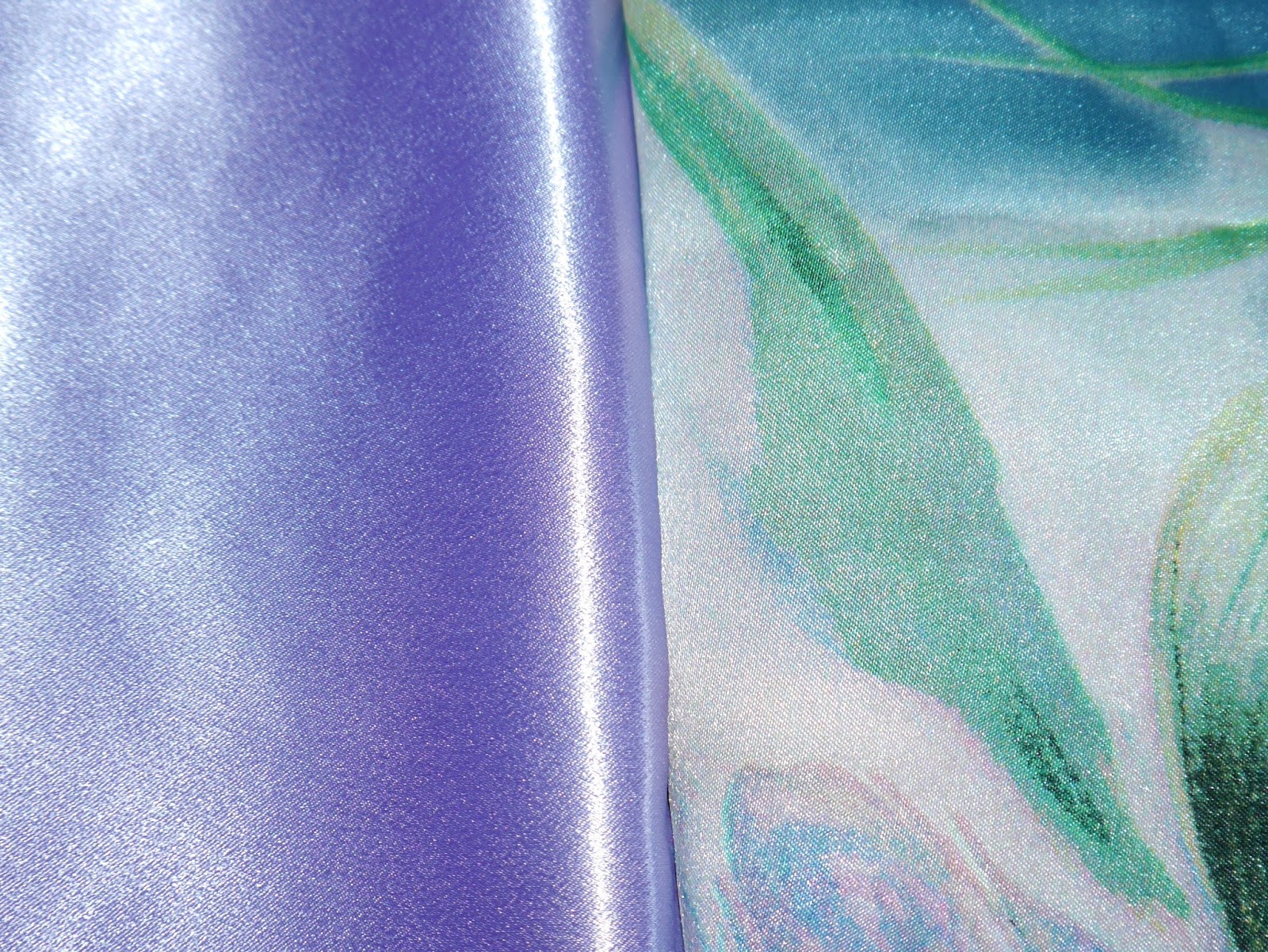
Woven filament Polyester fibres make beautiful silky satins that can be very fine or heavier Duchess, these are far less expensive than Silk, around 10-20% of the price depending on the weight and quality.  These are far more durable than Silk for garments and can be easily, if gently washed and drip dried.  The earlier Regenerated satins of the early 20th Century were swiftly superseded by Synthetics because they were cheaper and more durable.

Textured Synthetics
On the left is Polyester Taffeta, this is much crisper and retains its finish far longer than Silk Taffeta, although being really crisp it still creases easily despite being fairly easy to wash and iron.  The knitted cloth on the right is mixed with a Polyester metallic thread which shimmers but absolutely kills one’s scissors and needles!

Polyester and Acrylic soft furnishing fabrics
Because they are so hard wearing and because they can be easily made into many textures, Synthetic fibres can be mixed to produce heavy and highly textured upholstery materials that don’t fade and last much longer than their natural counterparts.  These cheaper materials have brought down the cost of furnishings for the homeor workplace and make these products more attainable for all budgets.  Because they need re-covering less frequently the life of furniture is extended as well.

All mixed up with Natural fibres
One can hardly escape Polyester/Cotton mixes like the Linen Look Poly/Cotton on the right and Poly/Cotton Suiting in the middle.  This is a superb mix of fibres, it has greater durability and colour fastness than pure Cotton and is softer and more breathable than Polyester alone.  Acrylic, used as short staple fibres mixed with Wool to reduce the cost and weight of cot fabrics, and makes cloth that is easier to launder and less prone to shrink.

Sewing with Synthetics

Synthetic fibres will wear out your scissors and needles far quicker than natural fibres.  I have a very special pair of hugely expensive tailor’s shears which I NEVER use on Synthetic materials, my Fiskars scissors get sharpened annually to keep them good and sharp – choose somewhere reputable for scissor sharpening , I use Franklins exclusively and give them some Silk Chiffon and demand that this be cut like a hot knife through butter every time!  I reserve certain needles for Silk cloth thus avoiding damaging expensive fabric with blunt needles that have been used for Synthetics.  If your machine skips stitches when sewing Synthetic cloth the needle is more than likely to be blunted so change it regularly to avoid this. 

Synthetic fabrics can slide around a fair bit when sewing so if you are just starting out use pure Cotton to start with and then move on to Poly/Cotton, which has a slightly different handle.  When you feel confident move on to more challenging materials take your time.  Some Synthetics can be difficult to ‘ease’ such as when you set in sleeves but this crispness is wonderful for frills and pleats.  Satin is very slippery so tac it in the seam allowance to make it easier for yourself.  

Stretch fabrics are as diverse as any other Synthetics; some are really difficult to sew with – especially those very fine shiny ones.  Most chunkier knits and fleeces are very straight forward using Jersey needles; using an overlocker alone (if you have one) set up to use four threads is ideal for seams, it saves oodles of time, retains the fabric’s stretch and finishes as you go.  Most of us (including me) don’t have a coverstitch machine, this is the machine that finishes hems on the right side with two rows of running stitch and on the wrong side covers the edge of the fabric with what looks like an overlocked stitch.  I would love one of these machines but they are only made for industrial use so you need lots of space and would need to be using it all the time to justify the outlay as they are single use machines.

Special Synthetics

Two more Synthetic fabrics you may want to experiment with are Faux Fir and PVC or Pleather.  These can not be ironed.  In the case of PVC you will need a Teflon sewing foot and foot plate for your machine to stop it from dragging as you sew and it is easily marked by stitching and pinning, it can be easily torn too so can only be sewn once – no unpicking mistakes or letting out garments made with PVC.  With Faux Fur you will need to be mindful of the pile, combing it away from the seam as you pin it and trimming the pile in the seam allowance after sewing.  You will need to use a larger gauge Jersey needle too.

Finally, don’t be afraid to experiment with Synthetics, as with every kind of fabric there are easy ones to begin with and more challenging fabrics to try out as you get more confident.  Go for it and make mistakes – if you know someone like me, who will have lots of scraps, ask to root through their scrap box and you will find lots of goodies to play with that won’t cost you much, if anything at all.

Have fun fellow sewers.


Monday, 9 January 2017

Lots of Linen


Linen is a plant fibre that is derived from the stalk of Flax plants.  Flax is grown in moist and cool climates with the highest quality coming from France, Belgium , the Netherlands and Ireland.  Coarser fibres are grown in Eastern Europe, New Zealand and Australia.

The fibre itself is part of the main stalk structure and is called ‘Bast’, which sits just under the surface of the stalk.  The Bast is removed from the stalk by a process called ‘Retting’ or rotting, this natural process is when the plant breaks down and releases the Bast for us to weave.  The finest quality Linens are left in the fields after cutting to allow dew and sunlight to break down flax stalks over 4-6 weeks, lesser quality fibres will be processed using lukewarm water which can speed up the process to around 3-5 days, chemicals can produce them far quicker – however the chemical process of retting makes course and weaker fibres that have less durability than those that are produced using natural methods.

Once the retted fibres have been collected they are dried for 1-2 weeks and then beaten and to remove the ‘shiv’ which is used to make chipboard.  Then it is combed to remove short waist fibres leaving the longer staples that are between 30cm-50cm long, these are smooth and lustrous.  It is then spun, dyed and woven into cloth.  All this processing makes Linen a relatively expensive fabric to produce, far more so than Cotton.

For a comprehensive history of Linen production across the world take a look at the CraigAvon Historical Society page, it is quite technical too which is somewhat appealing to a cloth geek like me.  For a less intense guide to Linen and it’s production in Ireland there is a great page on the FergusonIrish Linen website, although I have not purchased cloth from this company so don’t know what they are like to buy from.

The characteristics of Linen cloth are;
  • Has good moisture absorbency and is comfortable to wear, especially in warm climates
  • Is strong when wet or dry
  • Resists moth damage.
However is also;
  • Creases easily, ironed-in creases are very difficult to remove
  • Wears in folds and creases
  • Shrinks
  • Yellows with age
  • Shines when pressed without a cloth
  • Seam slippage can be a problem if the garment is tight
  • Susceptible to mould and damage buy silverfish.
And for makers you need to be aware that;
  • Frays easily
  • Does not ease well
  • Has poor elasticity.
An Irish Linen tea towel I use exclusively for pressing work
Linen is really good for protecting other fabrics during pressing when you are sewing, or just ironing your clothes made with delicate fabrics as it is lint free, if you keep them pressed and neatly folded they will serve you well for this purpose for years.

These are printed Linen fabrics for use in soft furnishings
The cloth on the left is a vintage piece that is unbleached and printed, it was produced in the 1970s/80s, the one on the right is a modern curtain fabric and is 100% Irish Linen which I have used to make Aprons and Fluffin Bags.

Natural coloured Linen Scrim
These two samples are naturally dyed, loosely woven fabrics that were used in the designs I made for Gracie Burnett when I worked for her.  This kind of Linen cloth is not the easiest to sew with as the loose weave suffers a lot with seam slippage and is not easy to launder.

Heavy Linen Suiting and Silk Linen Suiting
These two fabrics are very interesting, the brown Herringbone weave on the left is very crisp to sew with and frays like a mad thing; when sewing with this cloth I had to Overlock it immediately after cutting and before sewing with it because it practically unravelled otherwise – this made sharp corners practically impossible!  On the right is a Silk/Linen mix, this is a delight to sew with, it retains much of the strength of Linen and embraces the softness of Silk, the combination of these two fibres has produced a fabric that is less prone to creasing and is very cool for warm climates – I’ve made a few suits for my globe-trotting clients.  This cloth is available from Bennett Silks.

Some of the best Linen outlets are Ulster Linen, which I have not bought from myself although the website looks great, Ada & Ina which sell beautiful Linens for apparel and home furnishings in a wide range of weights and colours, although most of them are soft or neutral shades.  One of the suppliers Gracie used to use for naturally dyed Linen cloth is John EnglandIrish Linen
who also have a very wide range of colours and weights and their fabrics are of a beautiful quality.

Here are a few projects that I have made with Linen cloth over the years, it is pretty hard wearing and versatile, but if you are just starting out learning to sew I would develop your basic skills before tackling Linen.

A baby bag for a special pair of twins

Inside the bag
I made this bag for a relative who was having twins, a boy and a girl, and wanted a single baby bag that would accommodate all the paraphernalia for them both rather than having to lug around two bags.  It has a changing mat that rolls up and is stowed away in a zipped opening in the base.  The inside has been made using printed Linen curtain fabric and there are pockets for 2 bottles, 2 sets of nappies, 2x change of clothes and 2x favourite toys.  As far as I know it is still in use after several years – although the contents of the pockets have changed a bit!!

This is a prototype jacket made a number of years ago
It has been made with two different colours and weights of Linen, the frills are a little finer than the crisp blue Linen of the main jacket.


There are lots of contrasts in this jacket
This one has been made with two-tone, plain weave Linen, which is all naturally coloured, for the main body of the jacket.  The Linen holds the shape of the collar really well without piping because of the crisp quality of the cloth and makes it look really smart in my opinion.  All the darker panels have been made with Wool which is matt against the slightly lustrous Linen.


A skirt I found in a charity shop and fell in love with
I really love the way this lightweight Linen skirt swings as I walk in it, I rarely iron it either as it looks much more scruffy shortly afterward – I hang it up immediately after wearing or washing so that the creases drop out for the most part.  I have found this a good strategy for some (but not all) Linen garments, especially if they are bias cut or have a number of panels in the design.

Linen is a lovely cloth to work with and comes in a number of different weights;

  • Handkerchief Linen – sheer and lightweight
  • Lawn – loose weave a bit like muslin
  • Cambric
  • Linen sheeting – smooth & crisp
  • Dress Linens – medium weight 
  • Damask – smooth and lustrous used for top quality table linens
  • Crash – coarse slub Linens
  • Brown Holland – heavyweight

For those of you who like the look of Linen but don’t want the hassle of all the creases, there is a relatively new medium weight cloth made with plain woven Cotton/Polyester and is called Linen Look.  It is easy to sew with and washes brilliantly, there are lots of different printed patterns to choose from in places like Fabric Land, Hanson’s and many other stockists.

I hope you experiment with Linen fabrics in some of your projects, it is very robust for some things and I find that off-cuts make really good interfacings for tailoring.

Saturday, 17 December 2016

Cotton, natural and infinately flexible

Cotton is a plant based natural fibre, it comes from the fluff that protects the cotton seed which forms part of the ‘boll’ (the fluffy white seed head that includes the seeds, fluff and casing).  Cotton has been grown to make clothes for at least 7,000 years and has been recorded in the art of Egypt, India and throughout Asia, an intriguing perspective that includes creation myths in India are on the Handy EyeMagazine website.

The vast majority of the cotton used in clothing all over the world is grown in North America and is a cultivar that is a cross of the cotton plants native to the Americas and from the Middle East. Unfortunately the American cotton growing industry was expanded largely on the back of the slave industry during the 17th, 18th and 19th Centuries so it has rather a chequered history, it is like most industries now highly automated. A good guide to production in America is on the Cotton Counts website.

While on holiday in Yorkshire in the summer I heard a really interestingn article on the local news about a new Cotton Mill that will be the first in 30 years to spin Cotton in England.  This is truly historical as the North West was nick named Cottonopolis in decades past, thus named because over 90% of the world’s Cotton cloth was produced there.  The company is called English Fine Cottons and as their website states they are not yet fully up and running but it is a really exciting move for those of us making in the bespoke end of the market, and for anyone who is interested in good quality, UK produced products.

The fibres themselves can be grouped into three main types:

1. Long staple fibres – these are up to 55mm in staple length and are of the highest quality comprising the Sea Island Cottons which are the best quality and Egyptian Cotton, the second best.  Such long smooth fibres create the strongest, softest and finest Cotton fabrics.  During my final year at University I once visited the Jermine Street Shirt factory in Gloucester which supplies the Jermine Street shop just off Saville Row, they use South Island Cotton exclusively and it is the most beautiful of shirting cloths I have ever used and it played a big part in my final collection.  This cloth feels more like silk than cotton and creases somewhat less than most 100% Cotton fabric – it’s gorgeous!

2. Medium staple fibres – this is the largest group which makes up over 50% of the world’s Cotton.  It is dominated by the American types and is around 25mm or just over in length and is less smooth, strong and soft than the longer staples; it is far less expensive too.  This type is often mixed with other fibres such as polyester to create hard wearing, easy care cloth for school uniforms, workwear and cheaper bedding as well as a myriad of other products.

3. Short staple fibres – at less than 25mm these fibres are courser and rougher than the longer ones, they are mostly produced in the Indian Sub-Continent and other Asiatic nations.  The cloths made with these fibres have some fashion appeal in the “Ethnic” categories of products but are of a much poorer quality.

Cotton is the most versatile of fibres, it is used to make a huge variety of fabrics from the finest of Muslins and Voiles to the most durable and heavy weight Denims and Canvases.  Some of its major characteristics include;

  • It is the least reactive fibre so is the best fibre for sensitive skin
  • Highly absorbent, conducts heat well
  • Resistant to abrasion, moths and pilling
  • Can be cleaned by washing or dry cleaning
  • Easily takes up colour and is easy to print on
  • Super fabric for learning to sew with
  • Can be mixed with a huge variety of other fibres to enhance the qualities of both; e.g. Silk for greater softness & heat conductivity, Modul (a regenerated fibre that derives from tree bark) for softness, Polyester/Acrylic for easy care and durability
  • Cotton is the only fibre that gets stronger when it is wet
  • Conducts electricity 
  • Cotton is highly flammable 
  • Creases very easily indeed
  • Can easily shrink
  • Deteriorates with prolonged exposure to sunlight

Here is a list of some (though not all) of the fabrics made with Cotton fibres;
  • Utility cloths - Calico, Canvas, Cheesecloth, Denim, Flanelette, Hopsack, Net, Sailcloth, Terry Towelling, Ticking, Whipcord
  • Heavier weight apparel cloths – Bolton Twill, Corduroy, Drill, Fleece, Gabardine, Jersey,  Sateen, Velour, Velvet, Velveteen
  • Lighter weight fabrics – Chintz, Cluny Lace, Crepe, Gauze, Gingham, Muslin, Poplin, Seersucker, Voile.

From left to right here is some plain weave Denim, Cotton Ticking, Corduroy and some jacquard woven upholstery Cotton fabric.  These are pretty heavy weight cloths that can be used for hard wearing clothes and soft furnishings, I use them for bag making too, they carry machine embroidery and all sorts of applique beautifully.


In this photo, from left to right is a lovely Herringbone shirting which is a South Island Cotton and is super soft and smooth, printed polka dot Cotton, Muslin and woven striped Cotton that is dyed with natural dyes.


The last batch in this photo are Gingham, Jersey and Seersucker, these are really great for beginners because they introduce a small amount of challenge without too much difficulty, for the Jersey the only thing you need to remember to use a ball point needle for stretch fabrics and make sure you don’t stretch it when sewing – if you have an overlocker, set it up as a four threader and you don’t even have to use your normal sewing machine for perfect seams.

Cotton is probably the most versatile in the finishes of cloth available, both as a pure cotton fibre and as a mix with something else, it is also the best fabric to start using when learning to sew, even Cotton Jersey is quite straightforward to sew with, with the correct needle.  There are a HUGE variety of printed fabrics available to buy in a number of widths, years ago you could get it in 30” or 90cm wide – although this is rare these days, now it is usually available in 115cm or 45”, 150cm/60” and for bedding 3m/120” (although not so frequently in many suppliers).

Some of my favourite suppliers are;
  •  My fabrics.co.uk - this is a great online supplier of bargain fabrics and they usually have a vast array of colours, textures, patterns and weights 
  • Fabric Land – I love Fabric Land, they have lots of great fabrics at great prices, there are stores at Salisbury, Bournemouth, Ringwood, Bristol, Southampton, Basingstoke, Reading and Portsmouth; they also do a fantastic mail order service that I use all the time. 
  • Hansons Fabrics – Hansons is a bit of a textile heaven for those who sew, and especially for patchworkers, they have the largest range of printed Cottons I have ever seen, there is at least 1,000 designs at any one time on their shelves – it’s amazing!! They also stock lots of haberdashery items and are the only stockist I know that carries both Coates (my personal favourite) and Guttermann threads. They are happy to accept coach trips for larger groups and schools with some notice. It is a massive warehouse full of goodies that I can happily lose an hour or so in and the staff are lovely – especially my friend Ros. 
  • Croft Mill – This is a great company for beautiful suitings, they do have other fabrics available but I have only bought top of the range cotton suitings from them, the staff are lovely and they provide good sized sample swatches on request.
Cotton is so versatile you can make almost anything with it, from upholstery and soft furnishings, heavyweight utility items, hard wearing clothing, pretty dresses to the most intricate patchwork projects. I have had a look around lots of patchworking blogs recently and my current favourite one is Flossie tea cakes, she has a lovely site with lots of tutorials and patterns for some very sweet little projects and she has lots of beautiful patchwork projects too.

As I mentioned earlier it is the ideal starter fabric for learners of sewing, something like some nice plain cotton is best if you are a complete beginner, and when you gain some confidence try out patterns and experiment with how to change the look of projects using the pattern. Seersucker is marvellous for something with a little texture without being too challenging as it behaves itself very well indeed. I love Cotton, it is lovely and cool to wear in the summer and because it behaves so well it is easy to experiment with and the patterns of printed Cottons are pretty well unlimited if you shop around.

To show you a few examples of the kind of things I make for myself I tooksome snaps of some of my togs in the wardrobe;


On the left is a pair of jeans I made with some stretch denim from Fabric Land (that I bought years ago). Next is my brand new jacket – that I wore for the first time today – the purple corduroy was gifted to me with the proviso that I made something wonderful with it, so 1 embroidered waistcoat, and a full length skirt later, this swing jacket is the final piece of the set and sports Cotton Velour details in pink; and there is enough left to make another waistcoat in a different style. The skirt is an experiment made out old vintage printed Cotton that was part of my Aunty Vivien’s fabric library and some naturally dyed muslin and on the right is my favourite dress ever – every time I wear it, it causes a stir.


So this group starts with a godet skirt with printed fine polka dots, a great summer dress that I’ve not got round to wearing yet, my perfect denim skirt, which is the same cut as the polka dot skirt but with pockets and centre front zip (I love the printed denim) and another of my prototype jackets.  After this first one I have made lots of these jackets for clients and for my off the peg range.

I love working with Cotton, it’s wonderful to wear and versatile beyond belief so take a trip to your local stockist, or if you are in the area of Sturminster Newton call in on Hanson’s and drool over all the lovely Cottons they have there.


Sunday, 13 November 2016

A Touch of Silk

Silk fabric is made from the cocoons of Silk worms, these cocoons are made out of a single filament which is 600-900 metres in length.  The fibre itself is triangular in shape and transparent, this lends the finished silk its iridescent quality.  There is a really good history of Silk and its production on the Silk Road page which is very interesting and dates the production of Silk cloth to between 5000 and 7000 years ago.

Raw Silk has a distinctive soft cream/yellow colour and is made using the fibres before the naturally occurring gum, which holds the cocoon together, is removed.  This fabric is called Shantung Silk and the cloth has a very soft handle and heavy slub (uneven threads in the cloth).  This kind of cloth only comes in its natural soft shade as the gum prevents the take up of dyes.  Once the gum has been removed the dying possibilities are endless; most commercially dyed silks are dyed using industrial dyes and come in a huge range of colours.

There are also companies that use natural dyes to create a product that derives from more sustainable sources.  I used to work for a designer who specialised in using natural indigo from the Indigo plant, I once watched her dying some fabric and it was astonishing.  When dyeing with plant indigo the liquid in the dye vat looks somewhat like wee, but when the dyed fabric is exposed to the air it goes bright blue instantly – it’s amazing.  Natural dye stuffs were used right up until the industrial revolution when by products from many industrial and chemical processes were found to create lovely bright and fast colours for the textile industry – usually discovered by happy accident.  I found a couple of really good articles about natural dying if you are interested, the first is a good point of reference on the Pioneer Thinking website and here is an article on successful natural dyeing at home on the itty bitty impact website which shows you how straight forward natural dyeing could be.

Back to the matter in hand!  Silk is made into dozens of different kinds fabrics, from the heaviest brocades to translucent chiffon; there are soft, raw Silks, stiff grosgrains, crisp taffeta and duchess satin and fluid crepes.  Silk can be mixed with other fibres and is often mixed with the finest of Worsted Wool, Cashmere or Alpacca for a lightweight and very luxurious cloth and yarn, or Linen to create soft lightweight suitings that are softer than Linen alone and harder wearing than Silk alone.  Silk has special qualities that make it very highly prized.  It is super lightweight, incredibly strong, it is iridescent and warm in cold weather and cool in hot conditions.  However, it is easily damaged by perspiration and has to be cleaned very carefully.

The following pictures feature just a few examples of those Silk fabrics I have used a lot over the years.


Double Woven Silk Dupion, Shot Silk Dupion

Silk Dupion is what most people think of when they think of Silk, Princess Diana’s famed wedding dress was made out of ivory Silk Dupion.  Dupion has a slub in it and is quite a crisp, paper like cloth that creases easily but adds wonderful structure to garments.  These two examples are a taupe coloured power woven Dupion that creases a little less than most, the mauve on the right is from the Far East and is shot mauve/lime green.


Crepe backed satin, patterned Jacquard Silk

On the left of this picture is one of my all-time favourite fabrics, crepe backed satin.  On one side crepe backed satin is shiny and the other side is matt, this fabric is gorgeous and cascades in large pieces, like a waterfall.  The patterned jacquard on the right is made by the threads woven in such a way as to create a raised pattern, it is made in a similar fashion to brocade fabric.


Naturally dyed raw Silk, Devore Silk Velvet

These two Silks are naturally dyed with cochineal beetle shells that have been finely ground to create a fine powder that can be used for lots of different purposes; the cloth on the left is a heavy raw silk which is hard going to cut and kills sewing machine needles for a pass time, on the right is devore velvet.  Devore velvet is rather special, you can screen print the fabric with a special acid paint which when washed out removes the pile leaving translucent areas behind – Monsoon loves devore velvet!


Naturally Dyed Silk

Looking from left to right in this photo the first and third pieces of cloth are Kantha Silk, this is made in a fair trade workshop in Bangladesh and is produced by hand sewing in concentric squares a layer of silk which is backed with cotton scrim (like muslin). The second piece is the kind of silk fabric used for the Silk layer of the Kantha and the forth is Silk jersey.  Both the green and the blue in these samples are natural dyes.

Some of the other Silk fabrics widely available are;
  • Brocade – heavily patterned stiff cloth usually used for very rich garments and upholstery
  • Grosgrain – ribbed stiff cloth often used for upholstery
  • Crepe – comes in several weights from fine crepe de chine up to heavy Moroccan crepe, has a lovely soft fall and does not crease very much
  • Duchess Satin – stiff, soft sheen and frays like mad
  • Chiffon – lose woven very fine cloth which can be challenging to work with
  • Taffeta – tightly woven crisp fabric that rustles
  • Habiti – tightly woven fine cloth that kind of falls between chiffon and taffeta in character.

This is not an exhaustive list by any measure, there are many other finishes and weights available and specialist Silk outlets have a much wider range and stock a vast array of colours.

Silk can be less expensive to buy than one thinks depending on the quality and where you buy it, most general fabric shops will only stock Dupion, chiffon, crepe de chine, crepe backed satin and duchess satin as a rule and there will only be a few colour available; if you want a wider range of Silks there are several really good stockists in the UK, however, some will require you set up a business account with them – but you don’t need to buy loads of cloth to get one, as long as you buy something at least once a year they are fine with small purchases.  My favourite Silk merchants are Bennet Silks, they have lots of fabulous cloth and wonderful staff too.  The other two suppliers that I sometimes use are James Hare and Pongees, all three have great websites and they will send individual sample swatches or swatch cards with all the colours of a given cloth for a small charge.

A word about using Silk, in my opinion there is no such thing as a difficult fabric to sew with, as with all things you just need to practice to get the hang of it, for the best results here are a few tips;
  1. Measure twice, and thrice, cut once!  Silk is expensive so you don’t want to make any big cutting bloopers so measure grain lines carefully and pin in the seam allowance so you don’t mark the cloth.  When pinning the best pins are good quality glass head pins, glass head pins are made with better quality steal and are thus more expensive but worth every penny, pin quite close together to prevent slippage, around 3cm apart with fine cloth and around 5cm apart with heavier fabric.
  2. ALWAYS pin or tack your silk in the seam allowance when cutting and sewing.
  3. Use the right sized needle, you can generally use finer needles with Silk, crepe de chine and habiti need new needles as they mark easily with blunt ones.
  4. Tack your project if you don’t feel so confident, in the seam allowance, this is especially important with velvet as the pile in each piece will want to wriggle about a bit and will distort the seam if you are not on the ball.
  5. Use a scrupulously clean cotton/linen cloth/brand new tea towel to press silk as some can be water marked, when pressing velvet use a velvet board if you can get one to prevent flattening the pile – and lay it right side down; if you don’t have a velvet board use another piece of velvet to lay the right side against, this won’t entirely prevent flattening the pile but it does help.
  6. Be brave, don’t be afraid of the cloth, there are much more challenging fabrics than Silk in the synthetic fabrics that will slide all over the place, you just need to take your time and be methodical.
The following pics are some examples of the projects I have made using Silk over the years.


These scarves are double sided, often using two different Silks for each side and are piped at the edge, I love making these and they make lovely gifts.  Sometimes I make them with small pieces sewn together with mixed shades of similar colours, it is amazing what goes together and they end up being very useful garments that will go with lots of outfits, it’s a great idea for you to make something special for a delicious gift.


Embroidered Silk Dupion is more often used for curtains but it makes exquisite garments too, this butterfly patterned jacket was worn at the wedding of Prince William and Kate Middleton.


This was a really exciting project, the Silk velvet was part of an antique opera cape belonging to the client, she wanted to re-use it on a bespoke jacket so we selected a Mutka (raw) Silk that is woven with a silver lame thread.  To utilise the effect of the silver I designed the jacket with panels that are split just below the bust line and the lower panels are cut on the bias (diagonally) which gives the jacket a lovely soft fall over the hips and it gently flares at the hem.


This is the back of the wedding dress I made with the jacquard woven patterned Silk highlighted in photo 2, it was teamed with a heavy Moroccan crepe in pink for the details and I sent some of the jacquard to DM Buttons to make the matching covered buttons. You can see the dress in full in this article.

I hope you will consider sewing with Silk now if you haven’t before, it is a marvellous material to work with and the finish you can achieve is unique and totally luxurious – I love it!!  Silk is also really exciting as a medium for lots of textile techniques such as painting and a whole host of other ideas so if that is your thing, go for it, there are loads of books and courses about that kind of thing.

For something a little different to take a look at, Spider Silk has been used in Madagascar for hundreds of years, it creates something quite delicious, there is a fantastic video on YouTube so take a look, it’s fascinating. 
Enjoy

Tuesday, 25 October 2016

Woolly Works

The second instalment on fabrics and their properties is an exploration of Wool.  As you will all know Wool is a natural fibre that grows on Sheep which live anywhere there is grass to eat.  My fiancĂ© and I holiday in the Yorkshire Dales and they are EVERYWHERE, it’s funny when we have a bit of a stand-off when they are in the middle of the road!

Wool fibres range in length from 3.8cm right up to 50cm.  The shortest and finest fibres come from the Merino Sheep that are farmed mostly in Australia, South Africa and South America.  The wool from these sheep is the softest and most highly prized to make clothes; those of you who make your own felt will know just how soft they are.  Wool is an amazing material, it has astonishing properties and is incredibly versatile.
  • Short soft fibres 3.8cm-10cm long are made into the highest quality cloth and yarns for woven and knitted cloth.
  • Medium length fibres 7.5cm-20cm long are mixed with other fibres, both natural and synthetic, to make cheaper cloth and yarns.  These are derived from mostly British cross breeds such as Blue Faced Leicester and Jacob sheep.
  • Long fibres 15cm-50cm long are very course, strong and resilient and are therefore not suitable for clothing, they are called Carpet Types and are used for carpet.

The major useful properties of Wool are
  • Strength, Wool is incredibly hard wearing and retains its finish for many years if looked after properly.
  • Stretch, because of the natural ‘crimp’ in Wool fibres it is incredibly stretchy, in fact far more than any other natural fibre as it will stretch up to 30% depending on the spin and weave/knit.
  • Warmth, Wool is incredibly warm because of that ‘crimp’, it traps warm air and insulates against the cold more effectively than almost any other fibre.
  • Versatility, Wool is the most versatile fibre I have ever worked with.  It can be woven, knitted and felted into a huge variety of cloth from the finest Challis right up to heavy duty boiled Wool for coats, and other materials.  When old Wool clothing has reached the end of its life it can then be shredded and mixed with courser Wool fibres to make ‘Shoddy’ Wool which is used in blankets and insulating materials for the home and furniture industries.
  • Easy to manipulate, Wool fibres actually need very little to become the most basic of fabrics, felt, but once woven it can be easily shaped using steam and appropriate moulding tools.
  • Flame retardant, Wool does not catch light, it will smoulder after prolonged exposure to flame, this makes it very useful to the emergency services and for insulating our homes.


Natural Wool fleece, processed fleece and hand-made felt

In the photo you can see the difference in coarseness between the two dyed lots of Merino Wool and the two little bundles of fleece I found on holiday last year.  The felt is made out of a collection of Yorkshire fleece from the year before which I collected and made into felt.


All natural colours

All these yarns were spun by the West Yorkshire Spinners from fibres locally farmed and are un-dyed, they show the wide variety of naturally occurring colours from the palest cream to dark chocolate brown


Soft and smooth to chunky and thick

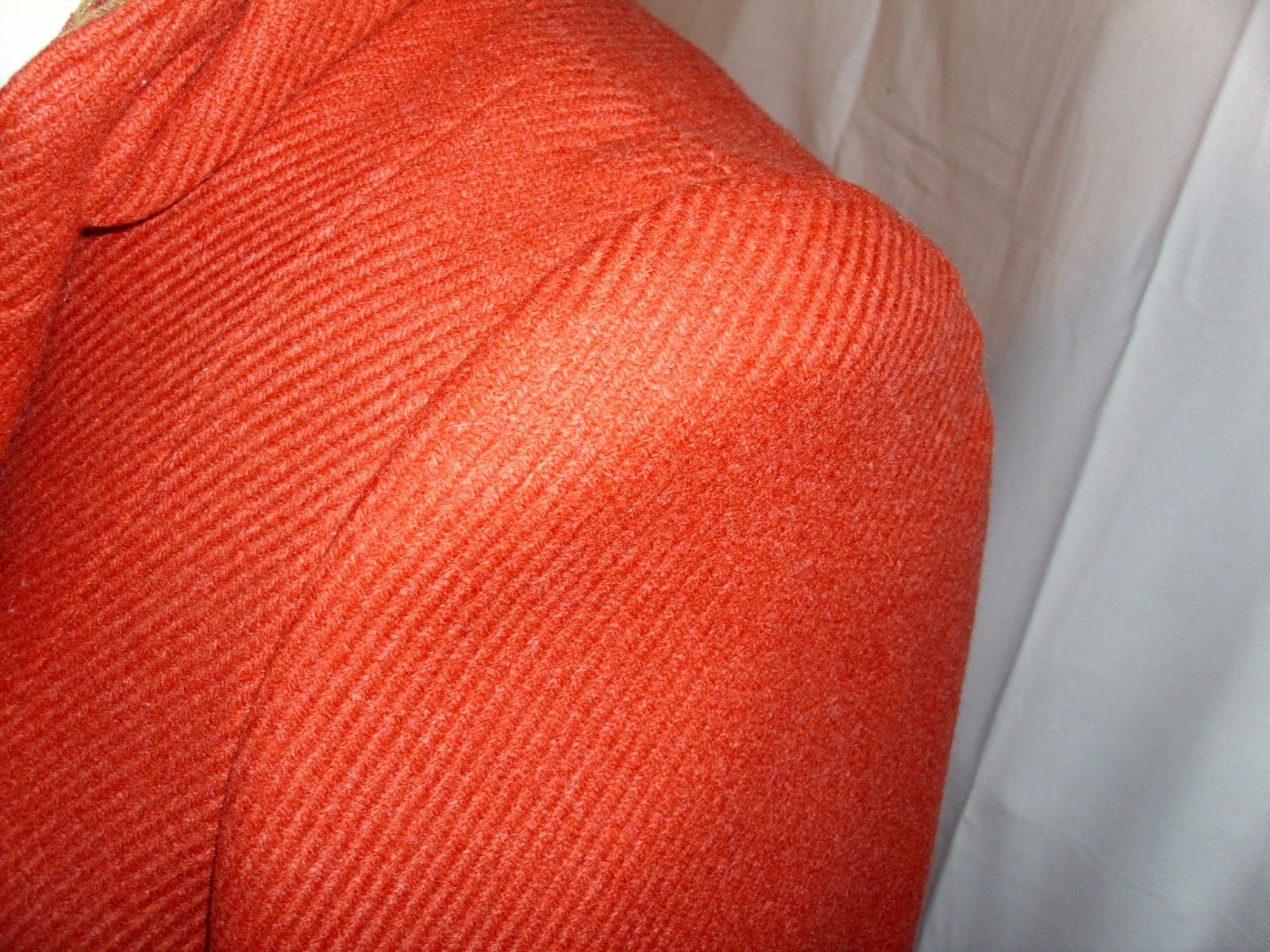
These three fabrics are all of the highest quality English cloth.  They grey pinstriped Worsted suiting is mixed with Cashmere to create a super smooth cloth with a beautiful ‘handle’ or ‘fall’ (these terms refer to how the fabric falls and how well it handles when it is being made up into clothes).  The navy Wool is a double woven (so that it has no right or wrong side) medium weight suiting.  And, the orange you might recognise if you have seen my orange coat, it is a heavy weight coating and I can vouch for its warmth believe me!!

Some of its more tricky properties are
  • Shrinkage, Wool can easily shrink when exposed to detergents, friction and steam, which is why when caring for wool garments you must follow the directions for cleaning.  This occurs because when exposed to the above the scales along the fibres are fluffed up and the fibres ‘knit’ together.
  • Susceptible to moth damage, little holes appear when the small moth larva eat the fabric, mothballs and treatments to wardrobes can prevent damage.
  • Weakened when wet, when washing knitted garments they must never be wrung out and have to be dried flat.
  • Often needs dry cleaning, this is the best way to clean most wool garments if you are not confident to clean it yourself.  You can brush most things off and surface clean gently to remove mud and easily removed marks, but to clean the whole garment, take it to the cleaners!

Before steam moulding

In this photo you can see that I have ‘eased’ this sleeve head, these sleeves are rather full and need to be eased a lot so they sit smoothly when set in to the garment, it is a fairly lose weave but needs a little help to look as beautiful as I want it to.


After steam moulding

I have used the end my sleeve board to mould the sleeve head of the sleeve using the steam from my iron, you will need a sleeve board and an iron that has a steam booster button and can steam upright to do this.  By steaming the cloth after easing you can shrink it so that there will be no wrinkles once the sleeve is set in.


This is the lovely smooth sleeve head once it is in the coat

Shrinking the eased sleeve head creates the perfect shoulder in any Wool jacket or coat.  Because there are lots of air spaces in between the fibres in Wool fabric it can be eased far more than any other fabric, and shrinking with steam gives you a huge amount of shaping potential in a garment.  This quality in Wool will also make a garment mould to the wearer over a number of years of regular use, this will only happen with pure Wool and not with Wool mixes.Some of the tools you might like to get are;

  1. Sleeve board, this is a small ironing board specifically for sleeves which is narrower at one end, the best are home made with wood as the wood retains the steam better for shaping, commercial ones are available but are not very durable.
  2. Ironing Roll, which is shaped a bit like a sausage and is stuffed with sawdust which retains the steam for moulding and shaping.
  3. Ironing Ham, same principle as the roll but shaped like a whole ham and is amazing for manipulating shoulders and bust areas.
  4. A great iron, this does NOT have to be expensive, in fact I usually spend no more than £15-£20, all it needs is a good sized water tank and a steam booster button as well as the facility to steam upright.
  5. Wooden rolling pin, this sounds a little weird but believe me, if you want nice flat seams you will want to use one, when steaming the seams open you apply the stream and then roll it with the rolling pin to ensure it retains the shape forever more.
Here is a list of some of the most common and well known Wool fabrics from down the centuries;
  • Blanket cloth
  • Boucle, a very soft fabric with a non-directional pile
  • Broadcloth, so named because it was much wider than most fabrics for making coats
  • Challis, soft and fine cloth traditionally used for making under garments, resembles muslin
  • Crepe, ‘bubbly’ cloth that is particularly good for dresses as it has a superbly soft fall and does not crease 
  • Flannel, used in suits for over 150 years
  • Harris Tweed, see my last post
  • Melton, this is woven and then boiled which makes it very easy to make with and does not fray
  • Worsted, this is the finest quality wool cloth and comes in a variety of weights
  • Wool jersey, this is a knitted cloth which has usually been pre-shrunk, but don’t assume that it has, if you want a more durable cloth that does not unravel when cutting it is advisable to pre-shrink by gently washing in a weak soft soap solution but do not wring it out – lay it flat on a bath towel and then roll it up like a Swiss roll to gently squeeze out the water.
This is of course not an exhaustive guide but you can extend your research by visiting the links in my previous posting called A Touch of Tweed for Harris Tweed and Moon Tweeds as they have lovely histories of their cloth. 
In my humble opinion Wool is the most versatile, wearable and amazing fibre because of its versatility and warmth.  However, there are some of you who are allergic to Wool or some of the by-products of the Wool industry, such as Lanolin.  Myself, I am allergic to Lanolin Alcohol which is derived from Lanolin and used as a finishing chemical for many woven Wool fabrics – bit of a pain for a tailor!  If you are allergic to Wool you might be able to wear other similar natural fibres such as Alpaca, which is fairly widely available and is now produced and spun in this country as well as elsewhere in the world.

Keep an eye out for the next fabric tutorial which will be on Silk, enjoy.


Thursday, 29 September 2016

A Touch of Tweed

At this time of year, with the change of season, one starts to think about all the cosy things in life, warm bowls of soup on rainy days, fluffy new socks and, if you make your own clothes – or like to have something cosy made, woolly things to wear.  You might like knitting or crochet and love nothing better than to have a new project keeping your lap warm and whiling away your evenings in front of costume dramas (I love Poldark, and Victoria – and Downton Abbey, oh how I miss Downton).  Me, I like riffling through my fabric boxes pulling together fabrics to make jackets and coats, redesigning them and referring to all the new season’s colours.  Not forgetting the all-important buttons – I spend ages deliberating over buttons!

The most versatile, hard wearing and divers fabric used in jackets and coats is Wool, which is incredibly hard wearing, gorgeously warm and acts a bit like plasticine with a bit of steam; it also moulds beautifully to the wearer over time – which is why when you try on a well-worn vintage jacket it feels weird until you have worn it in for yourself.  I used to have a huge WWII Naval Trench Coat in my early 20s which I wore with a tiny, tiny skirt, thigh length suede boots along with my bright red, corkscrew permed hair – thinking I was the bees knees.   The most fantastic wool fabric one can get is Tweed.

Tweed can be grouped together in to four main styles; 

Plain Tweed, on the left is shot Black & White and on the right is a printed plain tweed.

Plain Tweed can be bold or subtle, some are made with fibres that have been dyed before spinning and create the soft heather tones you see sometimes.  Some use two colours of thread such as the shot version in the photo above, and then others are embellished with printed patterns after weaving such as the one in the picture. 

Twill woven Tweeds

Twill woven Tweeds are generally in one single colour and come in a wide range of weights from very soft fine fabric to rather chunky and blanket like cloth.  If any of you see me out and about on really cold days you will see me in my orange coat made out of the orange tweed on the right of the picture. 

Herringbone Tweed is varied in pattern dependant on the design of the cloth to be made

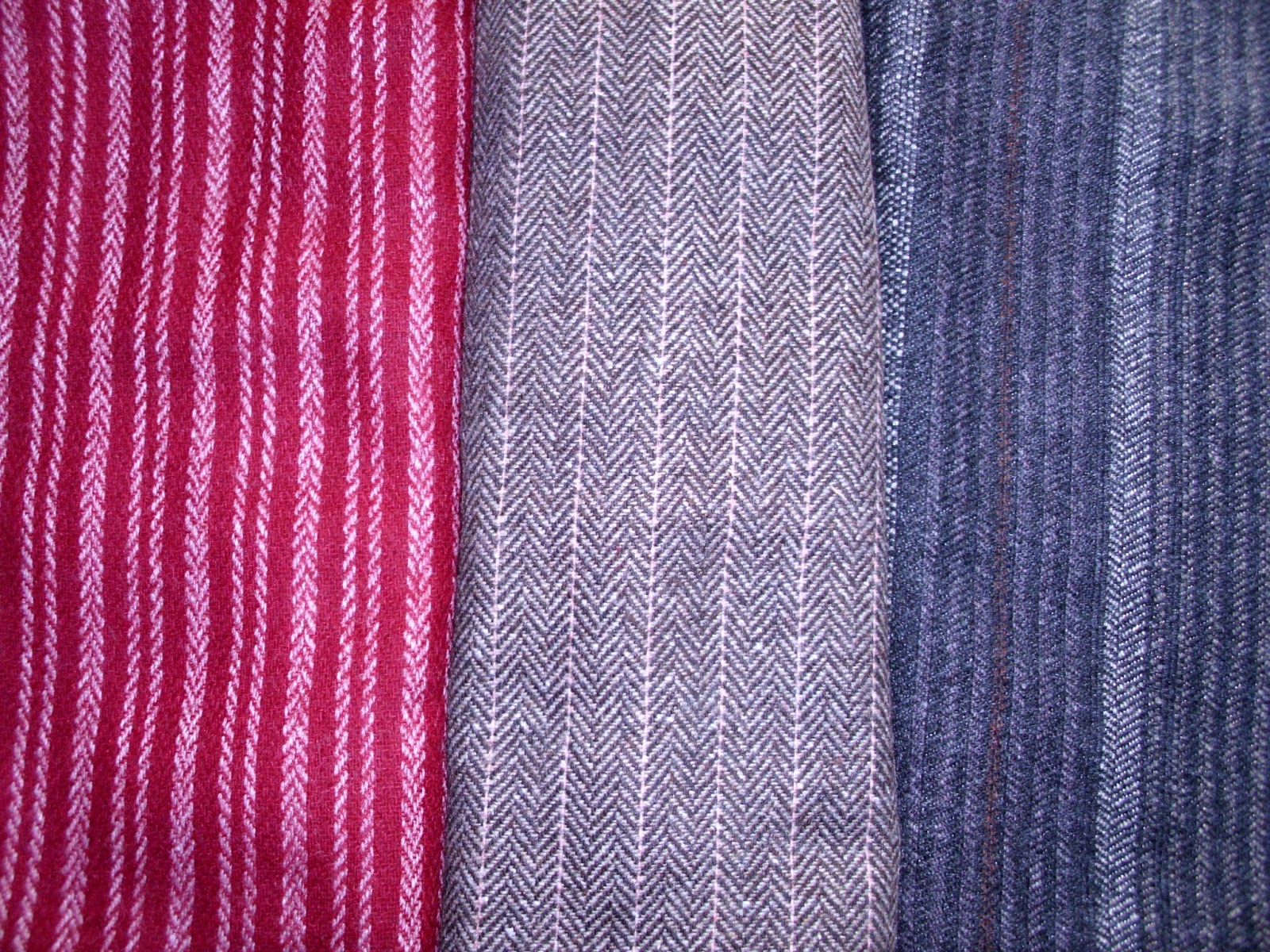
The Herringbone Tweed in the centre is very traditional and would be what most folk would imagine when they think of Herringbone Tweeds.  Either side are less traditional patterns that incorporate a variety of colours. 

Check Tweeds are even more varied in their pattern and use of colours

Check Tweeds are probably the most widely worn, and the tweed with the strongest associations with tailoring and culture.  In Scotland each one of the Clans has their own design of Tartan patterned Tweed which were greatly popularised by Queen Victoria and Prince Albert in the 19th Century after their first visit to Balmoral early in their marriage.  Nowadays there are a massive range of checked Tweeds to choose from, I particularly like a lot of the upholstery designs such as the second from the left in the above pic; it seems that weavers are letting loose their creativity and I for one love it.

The most famous Tweed cloth is probably Harris Tweed which has a long history and protected status nowadays.  The weavers all live on and around the Isles of Harris and Lewis in the Outer Hebrides in Northern Scotland and some produce their work as part of their life as Crofters, using local wool fleece, which is dyed locally and blended to produce the myriad of tones and colours that is unique to Harris Tweed as part of a cooperative group.  This is such a beautiful cloth and is a joy to design and work with.  Given the quality and special nature of this fabric it is in my humble opinion the pinnacle of wool fabrics and it is very good value for money.  One is only limited by your imagination when putting it to use – during my final degree collection I made a lined Bra with sky blue basket weave Harris Tweed, it was most pretty.

Every so often I go window shopping online to drawl over all the delicious colours and patterns that are available at Dashing Tweeds. I was lead to them by another tailor a couple of years ago who is also excited by all the pretty things they produce.

While on holiday in Yorkshire some time back I came across an outlet at the Courtyard Centre   where there was an shop stocking really inspiring jackets.  I got rather excited by the piano facings and creative use of patterned linings and bindings inside these jackets which were produced using Moon Tweeds which are made locally in one of the last remaining mills where raw wool is processed from fleece to finished cloth in the UK.  This year I discovered a smaller outlet that stocks offcuts of Moon cloth for craft uses at Quilting Antics just outside Settle where you can obtain it by the metre or by weight, if you take a look at the Moon website you can contact Quilting Antics and see if they have small pieces of the fabric you like – they have a vast variety in the shop to riffle through – it is cloth heaven for me!!!

Mixing it up

This waistcoat was a recent project made using two different Tweeds, Herringbone for the main body that I bought from Bernie the Bolt who has lots of fab things for very small prices; and the check Moon Tweed from Quilting Antics which was a small piece just big enough to cut the collar, pocket welts and send away the last few scraps to DM Buttons for them to make the covered buttons for me, which are truly lovely against the Herringbone.  Normally I tend to use far bolder colours but some people are more comfortable in softer tones, admittedly, having made this waistcoat I am rather enamoured with wearing Tweed like this now too.

Pocket and button details

As I was saying earlier, I take ages to choose buttons for each project, they can make or break the look of a garment, this is particularly true on fabrics like Tweed because of the tonal quality of the cloth.  Covered buttons are a brilliant solution to make them match the rest of the garment or as a contrasting detail, however, Wooden buttons are also lovely used with tweed because it too is a natural product and will blend beautifully such as the ones in the following photo, you may also consider Leather buttons which I have used in the past and which you will often find on Country Sports jackets in charity shops (vintage leather buttons are amazing on tweed).

How about embroidery too

When using Tweed one can utilise its strength to carry a wide range of embellishments, with my embroidery machine I regularly use text and picture designs to produce bold details on clothes and bags that make each piece unique to the ultimate wearer.

This is not an exhaustive look at the uses of Tweed, take a look at Tweeds and unleash your creativity. Tweed is hard wearing and incredibly versatile for clothes, soft furnishings and accessories as it is so durable and can be surface cleaned if the need arises – less dry cleaning needed than many other fabrics, the patterns also hide a multitude of sins.

Over the next few months I will be exploring lots of fabrics and their uses, addressing some of the more challenging ones and how to handle them.  If you are just starting out with sewing and want to make a big impact I would recommend Wool, and particularly patterned Tweed as it is so forgiving – just remember, steam is your friend.  The next piece will be about Wool in general and will explain how to make use of Wool fabric to achieve the best results for a project.

Enjoy, my sewing friends.