Showing posts with label Tutorial. Show all posts

Tuesday, 7 February 2017

Super Synthetics

This is the final instalment of my tutorials about Fibres and Fabrics, the focus this time is Synthetic Fibres.  There are three main groups of Synthetics;
  1. Nylon, first marketed as a fibre for apparel in 1938
  2. Polyester, the most widely used of the Synthetic fibres developed at the same time as Nylon but only perfected for clothing in the 1950s
  3. Acrylic, also arriving in the 1950s and the softest of the Synthetics.

These fibres came out of probably the most significant example of ‘pure’ research (research that has no particular end point and is an exploration of knowledge for its own sake) during the 20th Century; it has completely transformed the clothing industry.  Before the advent of Synthetics clothes were made out of natural, and in the early 20th Century Regenerated, fibres which were time consuming and costly to produce because of major limitations that dictated the amount and production of cloth. Making Synthetic fibres from the mid-20th Century onwards has been far less expensive and only limited by the availability of Petrochemicals, derived from Oil production, and the technology needed to produce them.

These fibres are produced by extracting sticky, string-like molecules from oil which are then melted and stretched in to a fine filament by various means according to the kind of Synthetic fibre to be made; Nylon becomes a harder and glass-like fibre, Polyester is a round filament that more closely resembles Silk, and Acrylic is softer than the other two.

All of the Synthetic fibres share some of their characteristics, the shared qualities being;
  • They collect or retain static electricity
  • Easily damaged by hot irons
  • Will quickly blunt needles and scissors
  • Skipped stitches and puckered seams can be a problem
  • Pills easily, (pilling is the formation of bobbles on the surface of the fabric)
  • Dries very swiftly after washing
  • Durable
  • Can be made in to a large range of products
  • Easy to dye and colour fast.
Each of these Synthetics though has individual qualities that make them suitable for different uses.

Nylon;

  • Shiny fibre
  • Elastic 
  • Woven fabrics fray easily
  • Dirt and lint cling to the surface and fabrics can cling to the needle.
Polyester;
  • Resist creasing
  • Has good elasticity and stretch recovery
  • Easy to launder and does not require ironing
  • Crisp and resilient
  • Resists moths, mildew and most chemicals
  • Fabrics are easier to sew after laundering
  • Has poor absorbency and can be uncomfortable to wear
  • Fabrics wear at garment edges
  • Attracts smoke and dust and needs cleaning more regularly.
Acrylic;
  • Resistant to abrasion, moths, sun and weather
  • Can be heat set to hold creases/pleats
  • Has low moisture absorbency but wicks well
  • Most are washable
  • Absorbs and holds perspiration
  • Some shrink badly.
However, the easy and inexpensive production, durability and the ease with which they can be mixed with other fibres makes them the prime material for making a huge variety of fabrics and other consumer goods.

My waterproof jacket

This extremely common product is a Polyester fleece lined waterproof jacket, I’ve had it for years and it still looks pretty good and does the job really well.
Super practical, lightweight shoes for all occasions
Many shoes, for all kinds of uses are made with Acrylic and Polyester materials, including the soles. From left to right are my peep toe Polyester elastic with Acrylic sole sandals, Acrylic suedette trainers and on the right are some Neoprene (a multi-layered Synthetic cloth developed for diving), Acrylic soled beach shoes.

Polyester clothing
Here are two very different finishes of Polyester cloth, on the left is a Velvet dress and on the right Georgette blouse.

Thread and notions 
Synthetic thread is the most widely used for sewing, the first three on the left are all different brands of Polyester sewing thread, the orange is the same fibre but with a lower twist value and only suitable for overlocking thread; these are produced by spinning together cut staple fibres to resemble cotton. Next come the fine and silky purple and metallic gold Polyester embroidery thread, made with spun filament fibres, and finally single filament invisible thread.  In the foreground are one of my Polyester woven labels and a Nylon (coil) zip.

Synthetic embellishments
Synthetic fibres have given rise to a massive explosion in the textures that can be achieved at little cost, ribbons and lace have become easy and very cheap to produce, the variety available is pretty well unlimited.

Nylon Linings
Nylon is shiny and makes a slippery cloth that is perfect for linings, the colour and texture of which can be varied easily in the weaving.  On the left is a twill lining and the centre and right are shiny textured linings.
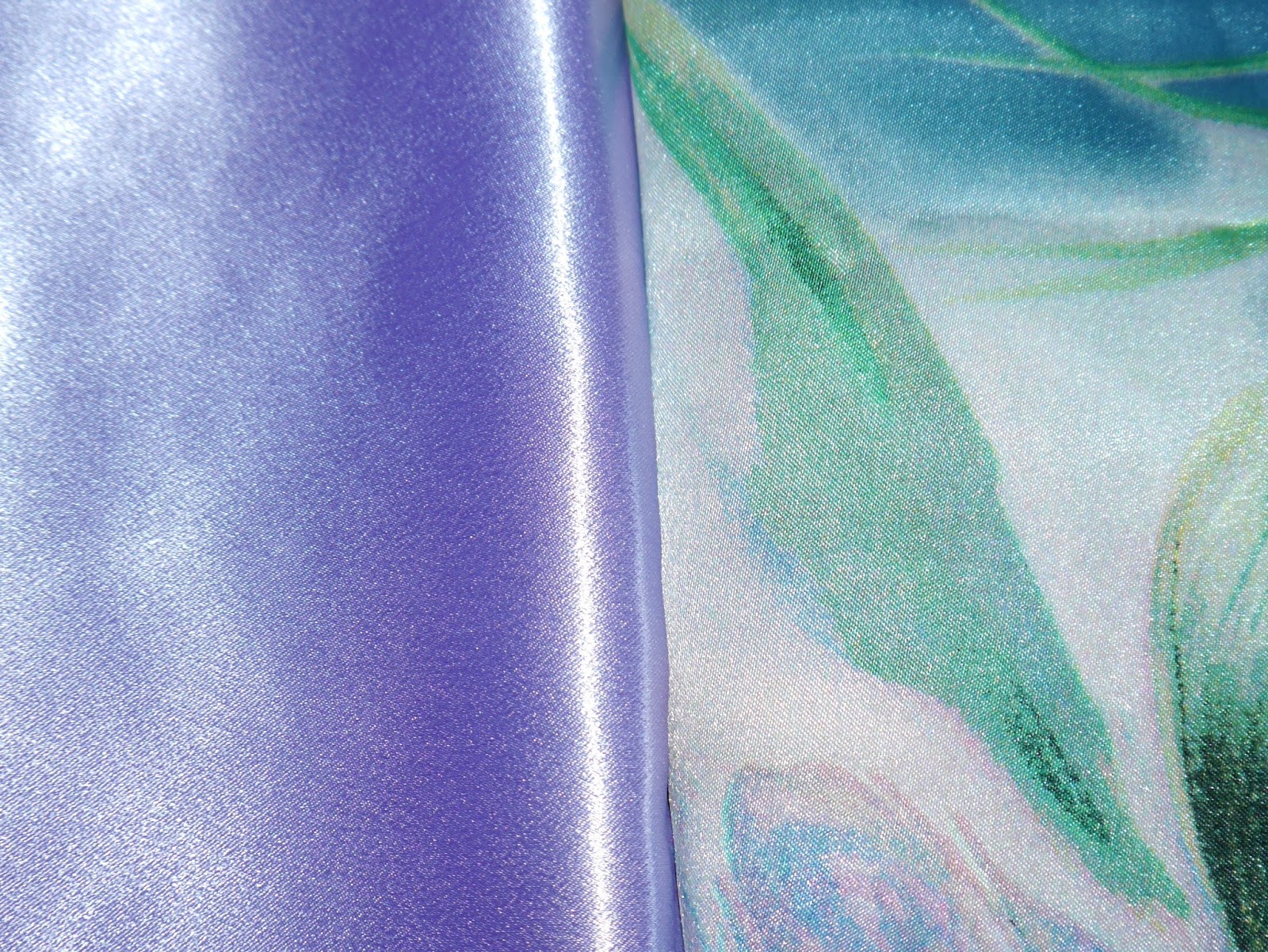
Polyester Satin
Woven filament Polyester fibres make beautiful silky satins that can be very fine or heavier Duchess, these are far less expensive than Silk, around 10-20% of the price depending on the weight and quality.  These are far more durable than Silk for garments and can be easily, if gently washed and drip dried.  The earlier Regenerated satins of the early 20th Century were swiftly superseded by Synthetics because they were cheaper and more durable.

Textured Synthetics
On the left is Polyester Taffeta, this is much crisper and retains its finish far longer than Silk Taffeta, although being really crisp it still creases easily despite being fairly easy to wash and iron.  The knitted cloth on the right is mixed with a Polyester metallic thread which shimmers but absolutely kills one’s scissors and needles!

Polyester and Acrylic soft furnishing fabrics
Because they are so hard wearing and because they can be easily made into many textures, Synthetic fibres can be mixed to produce heavy and highly textured upholstery materials that don’t fade and last much longer than their natural counterparts.  These cheaper materials have brought down the cost of furnishings for the homeor workplace and make these products more attainable for all budgets.  Because they need re-covering less frequently the life of furniture is extended as well.

All mixed up with Natural fibres
One can hardly escape Polyester/Cotton mixes like the Linen Look Poly/Cotton on the right and Poly/Cotton Suiting in the middle.  This is a superb mix of fibres, it has greater durability and colour fastness than pure Cotton and is softer and more breathable than Polyester alone.  Acrylic, used as short staple fibres mixed with Wool to reduce the cost and weight of cot fabrics, and makes cloth that is easier to launder and less prone to shrink.

Sewing with Synthetics

Synthetic fibres will wear out your scissors and needles far quicker than natural fibres.  I have a very special pair of hugely expensive tailor’s shears which I NEVER use on Synthetic materials, my Fiskars scissors get sharpened annually to keep them good and sharp – choose somewhere reputable for scissor sharpening , I use Franklins exclusively and give them some Silk Chiffon and demand that this be cut like a hot knife through butter every time!  I reserve certain needles for Silk cloth thus avoiding damaging expensive fabric with blunt needles that have been used for Synthetics.  If your machine skips stitches when sewing Synthetic cloth the needle is more than likely to be blunted so change it regularly to avoid this. 

Synthetic fabrics can slide around a fair bit when sewing so if you are just starting out use pure Cotton to start with and then move on to Poly/Cotton, which has a slightly different handle.  When you feel confident move on to more challenging materials take your time.  Some Synthetics can be difficult to ‘ease’ such as when you set in sleeves but this crispness is wonderful for frills and pleats.  Satin is very slippery so tac it in the seam allowance to make it easier for yourself.  

Stretch fabrics are as diverse as any other Synthetics; some are really difficult to sew with – especially those very fine shiny ones.  Most chunkier knits and fleeces are very straight forward using Jersey needles; using an overlocker alone (if you have one) set up to use four threads is ideal for seams, it saves oodles of time, retains the fabric’s stretch and finishes as you go.  Most of us (including me) don’t have a coverstitch machine, this is the machine that finishes hems on the right side with two rows of running stitch and on the wrong side covers the edge of the fabric with what looks like an overlocked stitch.  I would love one of these machines but they are only made for industrial use so you need lots of space and would need to be using it all the time to justify the outlay as they are single use machines.

Special Synthetics

Two more Synthetic fabrics you may want to experiment with are Faux Fir and PVC or Pleather.  These can not be ironed.  In the case of PVC you will need a Teflon sewing foot and foot plate for your machine to stop it from dragging as you sew and it is easily marked by stitching and pinning, it can be easily torn too so can only be sewn once – no unpicking mistakes or letting out garments made with PVC.  With Faux Fur you will need to be mindful of the pile, combing it away from the seam as you pin it and trimming the pile in the seam allowance after sewing.  You will need to use a larger gauge Jersey needle too.

Finally, don’t be afraid to experiment with Synthetics, as with every kind of fabric there are easy ones to begin with and more challenging fabrics to try out as you get more confident.  Go for it and make mistakes – if you know someone like me, who will have lots of scraps, ask to root through their scrap box and you will find lots of goodies to play with that won’t cost you much, if anything at all.

Have fun fellow sewers.


Saturday, 17 December 2016

Cotton, natural and infinately flexible

Cotton is a plant based natural fibre, it comes from the fluff that protects the cotton seed which forms part of the ‘boll’ (the fluffy white seed head that includes the seeds, fluff and casing).  Cotton has been grown to make clothes for at least 7,000 years and has been recorded in the art of Egypt, India and throughout Asia, an intriguing perspective that includes creation myths in India are on the Handy EyeMagazine website.

The vast majority of the cotton used in clothing all over the world is grown in North America and is a cultivar that is a cross of the cotton plants native to the Americas and from the Middle East. Unfortunately the American cotton growing industry was expanded largely on the back of the slave industry during the 17th, 18th and 19th Centuries so it has rather a chequered history, it is like most industries now highly automated. A good guide to production in America is on the Cotton Counts website.

While on holiday in Yorkshire in the summer I heard a really interestingn article on the local news about a new Cotton Mill that will be the first in 30 years to spin Cotton in England.  This is truly historical as the North West was nick named Cottonopolis in decades past, thus named because over 90% of the world’s Cotton cloth was produced there.  The company is called English Fine Cottons and as their website states they are not yet fully up and running but it is a really exciting move for those of us making in the bespoke end of the market, and for anyone who is interested in good quality, UK produced products.

The fibres themselves can be grouped into three main types:

1. Long staple fibres – these are up to 55mm in staple length and are of the highest quality comprising the Sea Island Cottons which are the best quality and Egyptian Cotton, the second best.  Such long smooth fibres create the strongest, softest and finest Cotton fabrics.  During my final year at University I once visited the Jermine Street Shirt factory in Gloucester which supplies the Jermine Street shop just off Saville Row, they use South Island Cotton exclusively and it is the most beautiful of shirting cloths I have ever used and it played a big part in my final collection.  This cloth feels more like silk than cotton and creases somewhat less than most 100% Cotton fabric – it’s gorgeous!

2. Medium staple fibres – this is the largest group which makes up over 50% of the world’s Cotton.  It is dominated by the American types and is around 25mm or just over in length and is less smooth, strong and soft than the longer staples; it is far less expensive too.  This type is often mixed with other fibres such as polyester to create hard wearing, easy care cloth for school uniforms, workwear and cheaper bedding as well as a myriad of other products.

3. Short staple fibres – at less than 25mm these fibres are courser and rougher than the longer ones, they are mostly produced in the Indian Sub-Continent and other Asiatic nations.  The cloths made with these fibres have some fashion appeal in the “Ethnic” categories of products but are of a much poorer quality.

Cotton is the most versatile of fibres, it is used to make a huge variety of fabrics from the finest of Muslins and Voiles to the most durable and heavy weight Denims and Canvases.  Some of its major characteristics include;

  • It is the least reactive fibre so is the best fibre for sensitive skin
  • Highly absorbent, conducts heat well
  • Resistant to abrasion, moths and pilling
  • Can be cleaned by washing or dry cleaning
  • Easily takes up colour and is easy to print on
  • Super fabric for learning to sew with
  • Can be mixed with a huge variety of other fibres to enhance the qualities of both; e.g. Silk for greater softness & heat conductivity, Modul (a regenerated fibre that derives from tree bark) for softness, Polyester/Acrylic for easy care and durability
  • Cotton is the only fibre that gets stronger when it is wet
  • Conducts electricity 
  • Cotton is highly flammable 
  • Creases very easily indeed
  • Can easily shrink
  • Deteriorates with prolonged exposure to sunlight

Here is a list of some (though not all) of the fabrics made with Cotton fibres;
  • Utility cloths - Calico, Canvas, Cheesecloth, Denim, Flanelette, Hopsack, Net, Sailcloth, Terry Towelling, Ticking, Whipcord
  • Heavier weight apparel cloths – Bolton Twill, Corduroy, Drill, Fleece, Gabardine, Jersey,  Sateen, Velour, Velvet, Velveteen
  • Lighter weight fabrics – Chintz, Cluny Lace, Crepe, Gauze, Gingham, Muslin, Poplin, Seersucker, Voile.

From left to right here is some plain weave Denim, Cotton Ticking, Corduroy and some jacquard woven upholstery Cotton fabric.  These are pretty heavy weight cloths that can be used for hard wearing clothes and soft furnishings, I use them for bag making too, they carry machine embroidery and all sorts of applique beautifully.


In this photo, from left to right is a lovely Herringbone shirting which is a South Island Cotton and is super soft and smooth, printed polka dot Cotton, Muslin and woven striped Cotton that is dyed with natural dyes.


The last batch in this photo are Gingham, Jersey and Seersucker, these are really great for beginners because they introduce a small amount of challenge without too much difficulty, for the Jersey the only thing you need to remember to use a ball point needle for stretch fabrics and make sure you don’t stretch it when sewing – if you have an overlocker, set it up as a four threader and you don’t even have to use your normal sewing machine for perfect seams.

Cotton is probably the most versatile in the finishes of cloth available, both as a pure cotton fibre and as a mix with something else, it is also the best fabric to start using when learning to sew, even Cotton Jersey is quite straightforward to sew with, with the correct needle.  There are a HUGE variety of printed fabrics available to buy in a number of widths, years ago you could get it in 30” or 90cm wide – although this is rare these days, now it is usually available in 115cm or 45”, 150cm/60” and for bedding 3m/120” (although not so frequently in many suppliers).

Some of my favourite suppliers are;
  •  My fabrics.co.uk - this is a great online supplier of bargain fabrics and they usually have a vast array of colours, textures, patterns and weights 
  • Fabric Land – I love Fabric Land, they have lots of great fabrics at great prices, there are stores at Salisbury, Bournemouth, Ringwood, Bristol, Southampton, Basingstoke, Reading and Portsmouth; they also do a fantastic mail order service that I use all the time. 
  • Hansons Fabrics – Hansons is a bit of a textile heaven for those who sew, and especially for patchworkers, they have the largest range of printed Cottons I have ever seen, there is at least 1,000 designs at any one time on their shelves – it’s amazing!! They also stock lots of haberdashery items and are the only stockist I know that carries both Coates (my personal favourite) and Guttermann threads. They are happy to accept coach trips for larger groups and schools with some notice. It is a massive warehouse full of goodies that I can happily lose an hour or so in and the staff are lovely – especially my friend Ros. 
  • Croft Mill – This is a great company for beautiful suitings, they do have other fabrics available but I have only bought top of the range cotton suitings from them, the staff are lovely and they provide good sized sample swatches on request.
Cotton is so versatile you can make almost anything with it, from upholstery and soft furnishings, heavyweight utility items, hard wearing clothing, pretty dresses to the most intricate patchwork projects. I have had a look around lots of patchworking blogs recently and my current favourite one is Flossie tea cakes, she has a lovely site with lots of tutorials and patterns for some very sweet little projects and she has lots of beautiful patchwork projects too.

As I mentioned earlier it is the ideal starter fabric for learners of sewing, something like some nice plain cotton is best if you are a complete beginner, and when you gain some confidence try out patterns and experiment with how to change the look of projects using the pattern. Seersucker is marvellous for something with a little texture without being too challenging as it behaves itself very well indeed. I love Cotton, it is lovely and cool to wear in the summer and because it behaves so well it is easy to experiment with and the patterns of printed Cottons are pretty well unlimited if you shop around.

To show you a few examples of the kind of things I make for myself I tooksome snaps of some of my togs in the wardrobe;


On the left is a pair of jeans I made with some stretch denim from Fabric Land (that I bought years ago). Next is my brand new jacket – that I wore for the first time today – the purple corduroy was gifted to me with the proviso that I made something wonderful with it, so 1 embroidered waistcoat, and a full length skirt later, this swing jacket is the final piece of the set and sports Cotton Velour details in pink; and there is enough left to make another waistcoat in a different style. The skirt is an experiment made out old vintage printed Cotton that was part of my Aunty Vivien’s fabric library and some naturally dyed muslin and on the right is my favourite dress ever – every time I wear it, it causes a stir.


So this group starts with a godet skirt with printed fine polka dots, a great summer dress that I’ve not got round to wearing yet, my perfect denim skirt, which is the same cut as the polka dot skirt but with pockets and centre front zip (I love the printed denim) and another of my prototype jackets.  After this first one I have made lots of these jackets for clients and for my off the peg range.

I love working with Cotton, it’s wonderful to wear and versatile beyond belief so take a trip to your local stockist, or if you are in the area of Sturminster Newton call in on Hanson’s and drool over all the lovely Cottons they have there.


Thursday, 26 May 2016

Setting in your piping

A few weeks ago I did a tutorial on making your own piping, I hope you have given it a go, I love using piping on all sorts of things and have used it:

  • To edge garments; like the front and collar of jackets & coats, and in necks and cuffs on wedding and occasional dresses
  • In seams; in the join of a yolk waistband, and as flat piping where lining meets facings in jackets
  • As embellishment; to create a window for reverse applique, at the edge of appliqued ribbon to give texture and body
  • Embellishing pockets; both edging pocket flaps on tailored pockets and flat at the top of a tailored pocket

Piping is so versatile and can give your project real finesse, piping can also be very helpful in helping items hold their shape such as a cuff or collar, and to induce tension where needed for example in a cross over bodice to stop gaping.

Here we go....


Piping has to be trapped in a seam so gather your piping and your fabric together – top tip, before you use this in a garment, practice, practice PRACTICE!


Pin the piping 1.5cm in from the edge of the fabric on the right side, top tip, my thumb is exactly 1.5cm wide so measure your fingers and find the one that is the right width so you don’t have to spend hours measuring with a ruler as you put each pin in.


Using your universal concealed zip foot, sew the piping to the fabric, using the stitching on the piping as your sewing guide.


This is what it should look like once you have sewn the piping on.


Turn it over.


Now pin your piped fabric to the other piece of fabric you are using, right sides together.


Using your previous stitching as your guide, sew the two pieces together just inside your previous stitching so that all the stitching is invisible on the right side.


The left had line of stitching is the new one.


This is what it should look like now on the right side before you press it.


If you are using the piping in a seam, press it flat with the seam allowance pointing towards the sides if on the front of the garment and towards the centre back if on the back of the garment.  Use plenty of steam, if the fabric is delicate cover with a clean cotton tea towel – I keep lots of these just for pressing.


– If the piping is an edging then turn the wrong sides together and STEAM!! Steam is your friend.


Contrast piping is wonderful in my humble opinion, so for those of you who love a splash of colour, go for it.

I hope that makes it look as simple as it is to execute, piping is a set of simple steps and until you get used to doing it just take your time and you will be fine.  When I teach this to my students they are always amazed at how straightforward it is to do, and more often than not piping appears in all their following projects because they love how it looks – so do I!

Have fun with it.

The universal concealed zip foot can be easily obtained in most sewing suppliers and online – I looked the other day and it was very reasonable indeed, my first one cost nearly £15, but you can get them for as little as £5 these days.  This foot is an amazing piece of kit, I don’t use that many feet at all, there is my standard work horse foot, my universal concealed zip foot, my Teflon foot for leather and PVC, and the buttonhole foot (I am going to invest in a walking foot soon too as there are projects that it will be very useful for but they are pretty expensive so not to be bought lightly for most of us) and that’s all you will ever need for the most part for garment making.


Thursday, 3 March 2016

Making your own piping

A handy tip for you, I teach this technique to all my students and once they know how to do it they are very enthusiastic to use it, it is not difficult, just a series of simple steps to follow.

1. Cut bias strip about 5cm wide (bias strip is cut diagonally)

2. Sew right side ends together at right angles to create one continuous strip

3. Press open and trim so that the seam allowance is around 3mm wide

4. Using woven (wound will unravel) cotton piping cord wrap the bias strip around, right side out, and pin

5. Using a concealed zip foot, as in the photo (there is another type of concealed zip foot that is a block with grooves on the underside that I personally would not give house room to!) sew along the side of the encased cord, the closer the better, but not sewing the cord intself.

6. After sewing, trim down so that the remaining flat fabric is around 1cm wide, this is what you will trap in the seam allowance when sewing it in to your project

Instructions on how to set in piping to follow at a later date. 

Step 1
Step 2
Step 3
Step 4
Step 5
Step 6